Lately I have been using a lot of ude garame. I use it when I practice jiyu waza. In free practice, I always try to take ikkyo or irimi as my primary techniques and move to secondary techniques only when the first don't quite gel.
Ude garame is an excellent secondary technique. Particularly when ikkyo ura doesn't quite connect, ude garame is right there to absorb resistance.
Yesterday. I saw a picture labeled ude garame except it appeared to be a reverse form. Instead of cutting uke's hand toward the fron of his shoulder, uke's arm bends the opposite direction and cut back and up toward the rear of his shoulder. Naturally, I had to try it.
It was slightly awkward to get a position where it made sense, but once the technique was applied, it turned out to be extrememly powerful. More powerful I felt than the usual version.
I learned that BJJ players call the technique the kimura after the judo man who used it to defeat Helio Gracie. I've seen a lot of talk about it in online circles but have never looked closely. Now I will have to go back and see what the fuss is about and how all of the grapplers like to use it.
Tuesday, October 21, 2008

Harmony
Here is an idea to explore. This morning I took a few minutes to play with a very basic kaeshi waza, receive ikkyo and turn it around and give it back. It was harder to get than I would have thought. Part of the problem was the language barrier. I couldn't really explain to my uke what I wanted to do and his level of resistance made it difficult to find the technique to practice it.
Then I tried something a little different. Instead of turning my body where I thought it was supposed to go I simply turned my body where it needed to go to keep my own hand lined up on my center. The result was that I started to get the reversal as well.
Then a little later as I was receiving shihonage, I tried the same principle. Instead of trying to move myself where I thought I should to take ukemi, I just moved my body to keep my center lined up with hand. In other words, I followed my hand with my center. The result was a very natural and relaxed ukemi.
It seems to me that this is what we generally do as tori. We line up our centers. I don't force my hand to my center; I gently move my center so it lines up with my hand and then I have a natural and easy power. So it makes total sense that I should be practicing the same approach as uke. After all, there are not two aikidos, one for offense and one for defense. As I move into a more fluid practice, there isn't even much distinction between tori and uke, there's just a constant flow pursuing alignment and the power that emenates from it.
Then I tried something a little different. Instead of turning my body where I thought it was supposed to go I simply turned my body where it needed to go to keep my own hand lined up on my center. The result was that I started to get the reversal as well.
Then a little later as I was receiving shihonage, I tried the same principle. Instead of trying to move myself where I thought I should to take ukemi, I just moved my body to keep my center lined up with hand. In other words, I followed my hand with my center. The result was a very natural and relaxed ukemi.
It seems to me that this is what we generally do as tori. We line up our centers. I don't force my hand to my center; I gently move my center so it lines up with my hand and then I have a natural and easy power. So it makes total sense that I should be practicing the same approach as uke. After all, there are not two aikidos, one for offense and one for defense. As I move into a more fluid practice, there isn't even much distinction between tori and uke, there's just a constant flow pursuing alignment and the power that emenates from it.
Sunday, September 21, 2008
Looking at Yonkyo
Yonkyo is hard. In fact, it is harder than it should be. I can't believe that a technique only works on some people some of the time would still be included in the basic curriculum. Therefore, I think that I'm missing some crucial element.
I've been looking at its mechanics and applications. First of all, it seems make more sense if I take it from a failed sankyo. Meeting resistance in sankyo, I can reverse direction and take yonkyo. That seems to help. Also, on occasion, yonkyo just appears; I've got uke's arm and uke is unbalanced. Uke's arm (elbow, shoulder) are arranged so that yonkyo makes sense. I haven't forced yonkyo, only spotted a timely opportunity.
This week I have started to look at the second hand. The focus is always on the hand that seizes the pressure point. Often it is hard to follow that grip with a movement that controls uke's shoulder and unbalances him. So I'm looking at my other hand. In every other technique the hands are cutting in sword fashion so why not yonkyo? What if that second hand, the one gripping the back of uke's hand, were to cut towards uke's center? What if it cut almost horizontally across uke's do (floating rib)?
I have a strong intuitive feeling that there is something right in all of that. Yonkyo starts to feel more akin to nikyo, sankyo or kote-gaeshi, all of which become available options as uke puts up a fight.
I tried this today with Hoang, a college student who trains at the dojo. I felt like I was getting the strongest, cleanest yonkyo I've ever had. It was a fast, sharp application. I asked him about it. He seemed to think it was solid but language is always a problem. On the other hand, Hoang is generally susceptible to yonkyo and is a cooperative uke. I'll need to work with a variety of uke's particularly the more combative and non-compliant ones and also some folks with bigger wrists.
I've been looking at its mechanics and applications. First of all, it seems make more sense if I take it from a failed sankyo. Meeting resistance in sankyo, I can reverse direction and take yonkyo. That seems to help. Also, on occasion, yonkyo just appears; I've got uke's arm and uke is unbalanced. Uke's arm (elbow, shoulder) are arranged so that yonkyo makes sense. I haven't forced yonkyo, only spotted a timely opportunity.
This week I have started to look at the second hand. The focus is always on the hand that seizes the pressure point. Often it is hard to follow that grip with a movement that controls uke's shoulder and unbalances him. So I'm looking at my other hand. In every other technique the hands are cutting in sword fashion so why not yonkyo? What if that second hand, the one gripping the back of uke's hand, were to cut towards uke's center? What if it cut almost horizontally across uke's do (floating rib)?
I have a strong intuitive feeling that there is something right in all of that. Yonkyo starts to feel more akin to nikyo, sankyo or kote-gaeshi, all of which become available options as uke puts up a fight.
I tried this today with Hoang, a college student who trains at the dojo. I felt like I was getting the strongest, cleanest yonkyo I've ever had. It was a fast, sharp application. I asked him about it. He seemed to think it was solid but language is always a problem. On the other hand, Hoang is generally susceptible to yonkyo and is a cooperative uke. I'll need to work with a variety of uke's particularly the more combative and non-compliant ones and also some folks with bigger wrists.
California Uke
This morning we had a guest at the dojo, a udansha from California who trains under Phong Sensei. He’s Vietnamese-American and hadn’t been back to Vietnam in 32 years. Consequently, when he got going on the mat he was sweating hard. Combine that with his physical build (short, stocky, think wrists and a musculature wired like coils of steel springs), and you have a very challenging uke. His limbs scarcely moved and his grip readily slipped off. I really struggled to get a hold on him and apply technique. My most effective efforts were some sutemi waza; I’ve really started to get into yoko otoshi.
He admonished me to keep flowing. If I don’t get one technique keep moving into the next. That was nice to hear. It’s not stressed enough, I think. Also, he talked about keeping my hands centered and demonstrated what he meant with a version of sankyo that reminded me of watching videos of Tissier Sensei.
Later, he called attention to initial movement, speaking of Saotome Sensei and the way he enters irimi, a slight movement taking him deep and off the line, small, calm, specific, hands rising and cutting down in perfect sword form.
I guess I don’t have any conclusions to make today. I’m more or less just thinking things through, and making myself aware that I am going to have to pay more attention to centering, relaxing, maintaining good form. In my effort to move and flow, I may be sacrificing form and composure. Perhaps I need to look again at my jiyu waza practice; I think I am on the right track but maybe just a shift in attitude would help, maybe a shift to something more centered, balanced, calm and sword oriented.
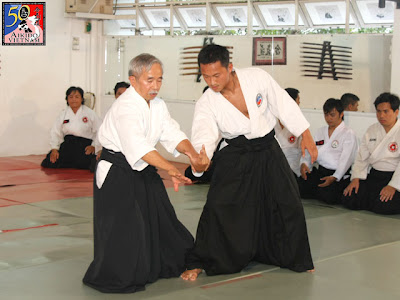
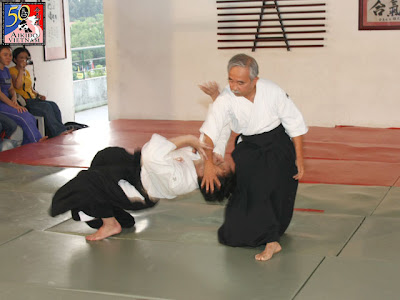
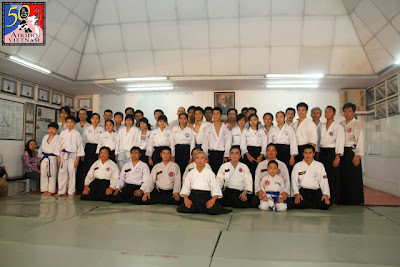
And since I neglected to talk about a visit from Phong Sensei some weeks back, I'll just say that I found him very impressive. He is a surprisingly small person, but so joyfully dynamic and powerful in his technique. Here are a few pictures:
He admonished me to keep flowing. If I don’t get one technique keep moving into the next. That was nice to hear. It’s not stressed enough, I think. Also, he talked about keeping my hands centered and demonstrated what he meant with a version of sankyo that reminded me of watching videos of Tissier Sensei.
Later, he called attention to initial movement, speaking of Saotome Sensei and the way he enters irimi, a slight movement taking him deep and off the line, small, calm, specific, hands rising and cutting down in perfect sword form.
I guess I don’t have any conclusions to make today. I’m more or less just thinking things through, and making myself aware that I am going to have to pay more attention to centering, relaxing, maintaining good form. In my effort to move and flow, I may be sacrificing form and composure. Perhaps I need to look again at my jiyu waza practice; I think I am on the right track but maybe just a shift in attitude would help, maybe a shift to something more centered, balanced, calm and sword oriented.
And since I neglected to talk about a visit from Phong Sensei some weeks back, I'll just say that I found him very impressive. He is a surprisingly small person, but so joyfully dynamic and powerful in his technique. Here are a few pictures:
Thursday, August 28, 2008
Response to Nikyo
I've been having fun playing with this. It seems to be a viable response to nikyo, at least where the nikyo involves pinning the wrist to shoulder area as opposed to keeping it at a distance.
Basically, when I feel tori taking the nikyo, I follow along. He's drawing me in and down, so I move purposefully in and down toward the lead side. This helps take some the pressure off my wrist.
Without pause, I immediately take a second step deep toward his other side, swing my hips around, and begin to sit down on that heel. As I drop, the first leg straightens naturally and checks his lead leg. His lead shoulder that was being used to secure nikyo is now being drawn out and down by that same nikyo.
Tori has become uke and takes a big fall.
This is a basic sutemi waza (sacrifice technique). I don't know exactly what it is called, but I see it in judo all the time. Judo is great for sutemi. The only difference is that I am applying it in response to a technique (nikyo) that I don't think exists in judo.
I'd like to learn more about judo, some proper, formal training. Next week I'll be in Guangzhou, China where they have no aikido, so I am hoping to find some judo players to work with while I am there. I can't imagine two weeks of no practice. Hopefully, it'll be an opportunity to prepare me for next year's move to Belize where again, they have judo but no aikido.
Basically, when I feel tori taking the nikyo, I follow along. He's drawing me in and down, so I move purposefully in and down toward the lead side. This helps take some the pressure off my wrist.
Without pause, I immediately take a second step deep toward his other side, swing my hips around, and begin to sit down on that heel. As I drop, the first leg straightens naturally and checks his lead leg. His lead shoulder that was being used to secure nikyo is now being drawn out and down by that same nikyo.
Tori has become uke and takes a big fall.
This is a basic sutemi waza (sacrifice technique). I don't know exactly what it is called, but I see it in judo all the time. Judo is great for sutemi. The only difference is that I am applying it in response to a technique (nikyo) that I don't think exists in judo.
I'd like to learn more about judo, some proper, formal training. Next week I'll be in Guangzhou, China where they have no aikido, so I am hoping to find some judo players to work with while I am there. I can't imagine two weeks of no practice. Hopefully, it'll be an opportunity to prepare me for next year's move to Belize where again, they have judo but no aikido.
Wednesday, July 23, 2008
Boxing Lessons
Thinking about boxing, clearly there is no one fixed approach to engaging the adversary. Unless you want to walk into a hook punch. The big idea is circular footwork, trying to come at and dominate the opponent’s center line without giving your own away. The big idea is to doggedly pursue the target zone, bobbing, weaving, slipping and dismissing the obstacles (punches) that come along and not making a big deal of them.
Is aikido any different? Probably not – or at least it shouldn’t be. Boxing is well proven and boxers incredibly effective and efficient. It is probably smart to take a page from their book. But how do I translate these strategies into aikido, into jiyu waza, randori?
Certainly, I always want the center line. I have been working that each day with jiyu waza, focusing on mirror movements of ikkyo and irimi. I've been coming very direct and assertive and feeling good about it. But this week I started allowing uke to include a little atemi as opposed to just grabbing, and now I am less certain. I think that at the same time that he going after uke's center line I am also giving mine away. The result is a clash where I tend to stick then win out by my size advantage.
I'm coming straight at uke. If we were boxing, I'd probably end up taking a jab right on the chin. Not good.
I keep looking for a fool proof movement that covers all the possibilities. I build little charts to see where the holes might be. I have never built a chart without holes. It might not be the right approach.
A better way may be to come at it like a boxer, moving fluidly, targeting my zone and not getting distracted by uke's grabs and strikes. Just keep moving. Just keep pursuing the goal of uke's balance, of turning uke's chin and upsetting his poise. Let the straight in charge give way to more circular footwork, to angling, to slanting, to turning a little tenkan.
Thinking about it, the classic ikkyo that I've studied was never a direct charge. It always involved a slight off the line approach. And irimi has an angle of its own. I should get back to that in my jiyu-waza.
It's something to work on.
Is aikido any different? Probably not – or at least it shouldn’t be. Boxing is well proven and boxers incredibly effective and efficient. It is probably smart to take a page from their book. But how do I translate these strategies into aikido, into jiyu waza, randori?
Certainly, I always want the center line. I have been working that each day with jiyu waza, focusing on mirror movements of ikkyo and irimi. I've been coming very direct and assertive and feeling good about it. But this week I started allowing uke to include a little atemi as opposed to just grabbing, and now I am less certain. I think that at the same time that he going after uke's center line I am also giving mine away. The result is a clash where I tend to stick then win out by my size advantage.
I'm coming straight at uke. If we were boxing, I'd probably end up taking a jab right on the chin. Not good.
I keep looking for a fool proof movement that covers all the possibilities. I build little charts to see where the holes might be. I have never built a chart without holes. It might not be the right approach.
A better way may be to come at it like a boxer, moving fluidly, targeting my zone and not getting distracted by uke's grabs and strikes. Just keep moving. Just keep pursuing the goal of uke's balance, of turning uke's chin and upsetting his poise. Let the straight in charge give way to more circular footwork, to angling, to slanting, to turning a little tenkan.
Thinking about it, the classic ikkyo that I've studied was never a direct charge. It always involved a slight off the line approach. And irimi has an angle of its own. I should get back to that in my jiyu-waza.
It's something to work on.
Monday, July 14, 2008
Trouble With the Kote-Gaeshi Pin
I've just had a realization regarding the kote-gaeshi pin.
Typically, when taking kote-gaeshi, uke lands on his back with tori still holding uke's wrist and arm in an advantageous position. Tori then cranks uke's arm to roll him on to his belly in order to apply the pin.
The problem is always an uncooperative or sluggish uke who decides not to roll over. It's quite difficult to force uke over and the situation easily devolves into a wrestling match. That's not very aiki, so what am I missing?
Now, I think I understand what I am missing.
It's really no different than an uke who refuses to follow tori around when tori controls his arm. He lets tori get behind him and then refuses to turn himself. The answer there is obvious. If uke refuses to participate in the fight, then there is no fight. But equally valid is tori's option of just choking out the dolt who stands there with his back to him refusing to move.
Same situation. From kote-gaeshi, uke lands on his back then refuses to roll over or move. There are two options. One, the fight is over. Two, tori can just kick and stomp him or take a front mount and start punching him in the face. I don't think that any of that is going to sound good to uke. Instead, the most logical and natural response for anyone being thrown on to their back is to try to get back up.
To get up from your back, you pretty much have to roll over at least partially to get to your knees. When uke moves to regain his feet, tori simply follows the movement and secures the pin. Tori doesn't need to force uke over. Uke wants to turn over, not to submit, but to get back up. Tori just follows uke's intention and uses the arm to steer uke into the pin.
I tested my idea out today. So far it is working smoothly, easily, and much more like what I imagine aikido to be all about.
Typically, when taking kote-gaeshi, uke lands on his back with tori still holding uke's wrist and arm in an advantageous position. Tori then cranks uke's arm to roll him on to his belly in order to apply the pin.
The problem is always an uncooperative or sluggish uke who decides not to roll over. It's quite difficult to force uke over and the situation easily devolves into a wrestling match. That's not very aiki, so what am I missing?
Now, I think I understand what I am missing.
It's really no different than an uke who refuses to follow tori around when tori controls his arm. He lets tori get behind him and then refuses to turn himself. The answer there is obvious. If uke refuses to participate in the fight, then there is no fight. But equally valid is tori's option of just choking out the dolt who stands there with his back to him refusing to move.
Same situation. From kote-gaeshi, uke lands on his back then refuses to roll over or move. There are two options. One, the fight is over. Two, tori can just kick and stomp him or take a front mount and start punching him in the face. I don't think that any of that is going to sound good to uke. Instead, the most logical and natural response for anyone being thrown on to their back is to try to get back up.
To get up from your back, you pretty much have to roll over at least partially to get to your knees. When uke moves to regain his feet, tori simply follows the movement and secures the pin. Tori doesn't need to force uke over. Uke wants to turn over, not to submit, but to get back up. Tori just follows uke's intention and uses the arm to steer uke into the pin.
I tested my idea out today. So far it is working smoothly, easily, and much more like what I imagine aikido to be all about.
Monday, June 30, 2008
Big Ideas
During the last month I have been trying to transform my aikido practice into something new. New to me at least.
I've taken some ideas from different sources and I am trying to unify and integrate them into something practical and meaningful. First, here is a list of some of the more important ideas.
The Fence. The fence is a very common sense idea that I am lifting from Geoff Thompson who has authored a whole series of books and DVDs on practical martial applications. The fence is simply a guard up position, but whereas a normal martial arts guard signals your opponent that you are about to go all Bruce Lee on him, the fence very casually says that you don't want any trouble. The hands are palm out, staggered, hovering around chest level. They keep him out of your face, bring you closer into his guard, help you judge distance, and allow you to either attack pre-emptively or respond to his attack. From an aikido perspective, the fence brings my hands up higher into a less passive or reactive starting point.
Mirrors. This comes from aikidoist John Bailey who practices a more contemporary aikido. Basically, a mirror is one body movement that produces two or more techniques depending on uke's position. For me, right now, the major mirror movement I am working on is ikkyo/ irimi. With my fence up, uke grabs my arm cross handed and I move right through him into ikkyo. Uke grabs again, this time non-cross handed, and I perform the same movement which now results in irimi-nage. One movement, two different results. I do not need to wait for uke to clarify his attack (which would be too late anyway). With my fence up, I sense the immediacy of uke's attack and move to meet him half way.
Compliments. Also from John Bailey. I think of compliments as an no nonsense approach to henka waza. Why complicate things? Certain techniques (when encountering resistance) feed logically into others. When they do, take them. I am seeing that compliments really tie in well with the next idea, pillars.
Pillars. I have seen this idea in several places. Basically, the idea is that not all techniques are created equal. Some are more straight-forward and universally applicable. These are pillars. One of my pillars is ikkyo (also part of my mirrors practice). Being a pillar, I will generally go for ikkyo whenever possible. But sometimes it may crumble, especially under stress. Then I look for its compliments, techniques that logically flow from and incorporate uke's resistance. For me, I often end up with sankyo (which can then take me back to irimi which is another pillar). I like pillars for a few reasons. For one, it gives me a focus; I no longer have dozens of options to choose from for responding to an attack. I just have to hardwire a few fundamental techniques. Pillars also lets me off the hook. A lot of techniques are just plain hard to make work most of the time. Pillars says that that's all right. They aren't supposed to work most of the time. Your core (pillar) techniques are the ones that are supposed to be your bread and butter; the rest are supplementary for meeting specific instances of resistance.
At the moment, my pillars are ikkyo, irimi, sumi otoshi (for lack of a better name), and shihonage. Focusing on these four shows a lot of examples of mirroring.
I've taken some ideas from different sources and I am trying to unify and integrate them into something practical and meaningful. First, here is a list of some of the more important ideas.
- The fence.
- Mirrors.
- Compliments.
- Pillars.
The Fence. The fence is a very common sense idea that I am lifting from Geoff Thompson who has authored a whole series of books and DVDs on practical martial applications. The fence is simply a guard up position, but whereas a normal martial arts guard signals your opponent that you are about to go all Bruce Lee on him, the fence very casually says that you don't want any trouble. The hands are palm out, staggered, hovering around chest level. They keep him out of your face, bring you closer into his guard, help you judge distance, and allow you to either attack pre-emptively or respond to his attack. From an aikido perspective, the fence brings my hands up higher into a less passive or reactive starting point.
Mirrors. This comes from aikidoist John Bailey who practices a more contemporary aikido. Basically, a mirror is one body movement that produces two or more techniques depending on uke's position. For me, right now, the major mirror movement I am working on is ikkyo/ irimi. With my fence up, uke grabs my arm cross handed and I move right through him into ikkyo. Uke grabs again, this time non-cross handed, and I perform the same movement which now results in irimi-nage. One movement, two different results. I do not need to wait for uke to clarify his attack (which would be too late anyway). With my fence up, I sense the immediacy of uke's attack and move to meet him half way.
Compliments. Also from John Bailey. I think of compliments as an no nonsense approach to henka waza. Why complicate things? Certain techniques (when encountering resistance) feed logically into others. When they do, take them. I am seeing that compliments really tie in well with the next idea, pillars.
Pillars. I have seen this idea in several places. Basically, the idea is that not all techniques are created equal. Some are more straight-forward and universally applicable. These are pillars. One of my pillars is ikkyo (also part of my mirrors practice). Being a pillar, I will generally go for ikkyo whenever possible. But sometimes it may crumble, especially under stress. Then I look for its compliments, techniques that logically flow from and incorporate uke's resistance. For me, I often end up with sankyo (which can then take me back to irimi which is another pillar). I like pillars for a few reasons. For one, it gives me a focus; I no longer have dozens of options to choose from for responding to an attack. I just have to hardwire a few fundamental techniques. Pillars also lets me off the hook. A lot of techniques are just plain hard to make work most of the time. Pillars says that that's all right. They aren't supposed to work most of the time. Your core (pillar) techniques are the ones that are supposed to be your bread and butter; the rest are supplementary for meeting specific instances of resistance.
At the moment, my pillars are ikkyo, irimi, sumi otoshi (for lack of a better name), and shihonage. Focusing on these four shows a lot of examples of mirroring.
Wednesday, May 28, 2008
Up A Notch
It is very hard to avoid thinking about whether my aikido would be at all effective in a real confrontation. I say 'my aikido' because I don't doubt that aikido is itself very effective. The techniques of aikido are the same techniques found in other arts like judo or jujitsu. It is only the implementation and focus that is significantly different.
So I look at books and videos of these other arts in action and try to understand what makes their practitioners so pragmatically effective. The base-line answer I always come up with is training style. They are practicing essentially the same techniques - maybe with an emphasis on groundwork or competition - but the techniques themselves are generally quite recognizable. What is different is attitude.
Judo and jujitsu both incorporate a lot of drills, free practice and competition. At least that's how it appears. Therefore, their practitioners all get regular experience in making techniques work under pressure against someone trying to prevent them from succeeding. In my normal aikido practice I get none of that.
I am sure there are some aikido dojos where people do get those experiences. I am only speaking to my own current situation here in Saigon. I feel myself repeating the same techniques over and over in a lackadaisical context, stuck continuously at the same level because no more is ever required of me.
I am convinced that if I want to take my aikido to the next level, if I want to know unequivocally that my aikido is effective, then I must ratchet up my practice to include outcome oriented drills, free practice, and, if not actual competition, at least a form of sport or game that requires tori and uke to have specific and opposing goals. I do not believe these things are contrary to the spirit of aikido. Not at all. Actually, I think they are essential and were probably inherent in the style until very recently. I just think that without formal competition, aikido has not had a clear litmus test to keep it strong. With each generation of practitioners, shortcuts and weaknesses slip into practice and there is no way to challenge these deficiencies short of someone from another style walking into the dojo and demanding a match.
Anyway, I don't have all the answers, and I think this will take me some time to work out. But I do have a few immediate ideas that I can take to the dojo to try to force a higher quality of practice.
So I look at books and videos of these other arts in action and try to understand what makes their practitioners so pragmatically effective. The base-line answer I always come up with is training style. They are practicing essentially the same techniques - maybe with an emphasis on groundwork or competition - but the techniques themselves are generally quite recognizable. What is different is attitude.
Judo and jujitsu both incorporate a lot of drills, free practice and competition. At least that's how it appears. Therefore, their practitioners all get regular experience in making techniques work under pressure against someone trying to prevent them from succeeding. In my normal aikido practice I get none of that.
I am sure there are some aikido dojos where people do get those experiences. I am only speaking to my own current situation here in Saigon. I feel myself repeating the same techniques over and over in a lackadaisical context, stuck continuously at the same level because no more is ever required of me.
I am convinced that if I want to take my aikido to the next level, if I want to know unequivocally that my aikido is effective, then I must ratchet up my practice to include outcome oriented drills, free practice, and, if not actual competition, at least a form of sport or game that requires tori and uke to have specific and opposing goals. I do not believe these things are contrary to the spirit of aikido. Not at all. Actually, I think they are essential and were probably inherent in the style until very recently. I just think that without formal competition, aikido has not had a clear litmus test to keep it strong. With each generation of practitioners, shortcuts and weaknesses slip into practice and there is no way to challenge these deficiencies short of someone from another style walking into the dojo and demanding a match.
Anyway, I don't have all the answers, and I think this will take me some time to work out. But I do have a few immediate ideas that I can take to the dojo to try to force a higher quality of practice.
- Insist that uke grab with intention. I already expect uke to strike with the intent of hitting me and not throw a hapless punch that misses me by a mile. Grabs are no different. The purpose of a grab is to seize control and I should expect uke to grab with force and a desire to take my balance.
- Insist that uke follow up any strike with another. If uke throws one strike and stops, he is not mimicking a genuine flow of energy. Techniques work by capturing the flow of the attacker's energy. If the attacker halts his attack, there is no reason to continue to respond.
- Pressure uke to attack again immediately. After uke receives a technique he should take the shortest possible route to a renewed attack. This then limits the amount of thinking that tori can do. Tori just needs to respond.
- To help uke keep the pace moving, pursue him after the throw. Stay with him. Stay in his space. Even initiate the next encounter by striking first and forcing uke to react.
- Do not practice techniques in the same sequence all the time. This is especially true with the 'numbered' techniques. Mix it up. Reverse the sequence. Do evens then odds. Uke doesn't need to know what technique is coming.
- Especially with grabs, try to respond according to the direction of the energy. Uke grabbing and pulling should elicit a different technique than uke grabbing and shoving.
- Do not practice techniques piecemeal. Don't be choppy. I can think of two ways to work through a technique without getting choppy.
- Slow and smooth with deep, clean breathing. Or...
- Uchikomi. I don't know if I am using the term correctly. But this is what I mean: working at speed, launch into the first part of the technique. Just keep hitting that first part, keep setting it up and backing out. Do it repeatedly until your are mentally ready to run through to the finish. Maybe you do it three times and on the fourth you pierce through to the completed throw. This is done a lot with hip throws but maybe it would be helpful with other techniques.
- Practice jiyu waza at the beginning of class before time runs out. Initially start with grabs only. Maybe even one specific grab and each week after add another. When a barrage of grabs can be handled effectively, consider adding strikes. Utilize all available techniques and do not limit yourself to just a few favorites. You want to be able to make all techniques work under pressure.
Wednesday, May 21, 2008
Tuesday, May 20, 2008
Thoughts on Kokyu-nage
I continue to struggle with kokyu-nage, or at least with certain versions of it. For example, ikkyo into kokyu. Or off a punch or strike where I enter on the outside and draw uke around and down and then take kokyu. With these situations I feel like I end up muscling through kokyu. I feel slightly off balance myself or like kokyu isn't really there and I am forcing it.
Reflecting after class today I remembered something I read recently comparing some technique from Daito Ryu to Aikido's kokyu-nage. It said they might look the same but that the first is executed with a vertical circle and the second, the kokyu-nage, is executed with a horizontal circle.
Now I know that the people I practice with are performing kokyu-nage in a very linear pull-push sort of way. I try to avoid that. I am trying to think circular. But I still meet resistance. So I started thinking about what is like to receive kokyu-nage. I thought about receiving the pull-push version and how as uke I feel like I am in a strong stance to resist. My balance is not taken unless I have been pulled so far forward that I fall that way and then what is the point of kokyu-nage? So I thought what it would feel like to receive it as a horizontal circle.
I imagine my arm being projected across my center line, being projected forward from (rather than clutched to) uke's center. The elbow is even with or lower than the wrist. Suddenly, my strong stance is corrupted. Weight shifts to the outside of the forward leg. By body tips slightly into uke. I'm pivoting a bit on the horizontal. Uke needs only a gentle motion to complete the throw. If he wanted, he could choose a gentle kiri-otoshi like move rather than kokyu.
I have tried to visualize how I might perform the technique this way, controlling not just uke's wrist but his elbow as well. Especially his elbow so that I can project it subtly across his center line in order to initiate a horizontal circle. I think there is something here. Now I will have to take it to the mat.
Ahh! An after thought. I also can see an alternate version. I would still first need to create that horizontal circle. But then in a situation where for some reason my arm is not in a position to cut smoothly through uke's center (maybe uke's shoulder is in the way or I just screwed up), I can use my elbow. My elbow can come up under the chin and keep going so that my hand is in uke's face. Sliding over his face, the hand finds his far shoulder to draw him round and down like kiri-otoshi. Seems hard to explain clearly, but in my mind's eye it feels quite simple and natural.
Reflecting after class today I remembered something I read recently comparing some technique from Daito Ryu to Aikido's kokyu-nage. It said they might look the same but that the first is executed with a vertical circle and the second, the kokyu-nage, is executed with a horizontal circle.
Now I know that the people I practice with are performing kokyu-nage in a very linear pull-push sort of way. I try to avoid that. I am trying to think circular. But I still meet resistance. So I started thinking about what is like to receive kokyu-nage. I thought about receiving the pull-push version and how as uke I feel like I am in a strong stance to resist. My balance is not taken unless I have been pulled so far forward that I fall that way and then what is the point of kokyu-nage? So I thought what it would feel like to receive it as a horizontal circle.
I imagine my arm being projected across my center line, being projected forward from (rather than clutched to) uke's center. The elbow is even with or lower than the wrist. Suddenly, my strong stance is corrupted. Weight shifts to the outside of the forward leg. By body tips slightly into uke. I'm pivoting a bit on the horizontal. Uke needs only a gentle motion to complete the throw. If he wanted, he could choose a gentle kiri-otoshi like move rather than kokyu.
I have tried to visualize how I might perform the technique this way, controlling not just uke's wrist but his elbow as well. Especially his elbow so that I can project it subtly across his center line in order to initiate a horizontal circle. I think there is something here. Now I will have to take it to the mat.
Ahh! An after thought. I also can see an alternate version. I would still first need to create that horizontal circle. But then in a situation where for some reason my arm is not in a position to cut smoothly through uke's center (maybe uke's shoulder is in the way or I just screwed up), I can use my elbow. My elbow can come up under the chin and keep going so that my hand is in uke's face. Sliding over his face, the hand finds his far shoulder to draw him round and down like kiri-otoshi. Seems hard to explain clearly, but in my mind's eye it feels quite simple and natural.
Receive Kokyu-Nage, Take Aiki-Otoshi (Part 2)
A few days ago, I mentioned a serendipitous discovery where I was able to receive kokyu-nage and take aiki-otoshi. It seemed to produce the best aiki-otoshi I'd ever been able to do. The problem was that my uke was a very small guy, and I didn't know if I was getting aiki-otoshi based on good technique and a legitimate opportunity or if I was only using my greater mass to bowl him over. Today, I got to try it out again. This time with a much larger uke. He is at least my size. Taller actually.
Like a lot of folks here, he exaggerates his movements and tends to sacrifice his own posture. So the chance was there. He was really pulling me right into aiki-otoshi. I took it. It worked flawlessly. I had the chance to repeat it several times. Again, they were some my best executed aiki-otoshi.
I cannot express how happy I am to have some success on the mat.
Like a lot of folks here, he exaggerates his movements and tends to sacrifice his own posture. So the chance was there. He was really pulling me right into aiki-otoshi. I took it. It worked flawlessly. I had the chance to repeat it several times. Again, they were some my best executed aiki-otoshi.
I cannot express how happy I am to have some success on the mat.
Thursday, May 15, 2008
Ikkyo Into Tembin or Shiho-Nage
Here is one I have seen but haven't tried yet. But I want to make some notes right away lest I forget all about it.
Tori goes for ikkyo but fails to get it. Uke is resisting. Tori doesn't get enough of uke's elbow so uke remains a little too upright with the elbow noticably above the wrist. Tori lets his grip on uke's wrist shift a bit and lets the other hand drop behind and beneath the elbow (as opposed to trying to force the elbow down). Tori extends and enters right into tembin-nage or, possibly meeting other resistance, pivots tenkai into shiho-nage ura.
Tori goes for ikkyo but fails to get it. Uke is resisting. Tori doesn't get enough of uke's elbow so uke remains a little too upright with the elbow noticably above the wrist. Tori lets his grip on uke's wrist shift a bit and lets the other hand drop behind and beneath the elbow (as opposed to trying to force the elbow down). Tori extends and enters right into tembin-nage or, possibly meeting other resistance, pivots tenkai into shiho-nage ura.
Sankyo Into Irimi-Nage
I just saw a quick video on YouTube showing how sankyo might become irimi-nage.
For whatever reason, sankyo is not going according to plan. Uke tries to spin out of it and clock tori with a cross body elbow. Tori relinquishes sankyo. The secondary (outside hand) comes up to guard against the elbow. At the same time, tori moves closer in away from the force of the strike, and the primary (inside) hand slips up under the elbow and across uke's body to deliver irimi.
It looked rather effective, and the issue of uke spinning out does happen, so I am sure I will get to try this sooner or later.
For whatever reason, sankyo is not going according to plan. Uke tries to spin out of it and clock tori with a cross body elbow. Tori relinquishes sankyo. The secondary (outside hand) comes up to guard against the elbow. At the same time, tori moves closer in away from the force of the strike, and the primary (inside) hand slips up under the elbow and across uke's body to deliver irimi.
It looked rather effective, and the issue of uke spinning out does happen, so I am sure I will get to try this sooner or later.
Receive Kokyu-Nage, Take Aiki-Otoshi
A serendipitous discovery. Today's practice focused on kokyu-nage, and I worked with several people. While taking the role of uke, I tried to follow and flow with the different techniques, keeping open to possibilities for reversals.
Here in Saigon we practice a technique with the unhelpful name Kokyu-Nage #7. Basically, it involves tori initiating ikkyo, meeting resistance and slipping and turning under uke's arm to a position where a more traditional and standard kokyu-nage can be taken. In that position, before tori really goes for the final kokyu, I was able to take aiki-otoshi.
A lot of folks that I train with here tend to over exaggerate their movements. With Kokyu-Nage #7 they often hurry beneath my arm without getting any of my balance. Then they try to really drag me out and down to set up their kokyu throw. That exaggerated motion practically pulls me into aiki-otoshi, letting my rear leg come forward and enter deep behind them. My body easily enters across their body to break their balance, and all that remains is for me to snatch their feet out. In fact, I did it several times today while under a little pressure to repeat myself and each time was among the best aiki-otoshi I've ever pulled off.
The caveat is that my uke were substantially smaller than me. So, did it work based on my technique or my mass? That's what I'll have to explore.
Here in Saigon we practice a technique with the unhelpful name Kokyu-Nage #7. Basically, it involves tori initiating ikkyo, meeting resistance and slipping and turning under uke's arm to a position where a more traditional and standard kokyu-nage can be taken. In that position, before tori really goes for the final kokyu, I was able to take aiki-otoshi.
A lot of folks that I train with here tend to over exaggerate their movements. With Kokyu-Nage #7 they often hurry beneath my arm without getting any of my balance. Then they try to really drag me out and down to set up their kokyu throw. That exaggerated motion practically pulls me into aiki-otoshi, letting my rear leg come forward and enter deep behind them. My body easily enters across their body to break their balance, and all that remains is for me to snatch their feet out. In fact, I did it several times today while under a little pressure to repeat myself and each time was among the best aiki-otoshi I've ever pulled off.
The caveat is that my uke were substantially smaller than me. So, did it work based on my technique or my mass? That's what I'll have to explore.
Friday, May 9, 2008
Repairing Uke
Yesterday, I got fed up and expressed that frustration here. Today, I want to think about some of those complaints and try to find more practical responses.
One of my most common frustrations and one of the greatest detriments to productive training is an uke who doesn't understand their role. An uke is not a punching bag or piece of exercise equipment. Uke is practicing aikido as much as tori. In fact, if uke fails to grasp their role and to behave in an aiki way, then they are hindering their own progress as well as tori's.
Here are some of the most common and easily repaired uke deficiencies:
Strikes that miss the target. A huge piece of aikido is learning to calmly read uke's intent, energy and direction. When uke throws a strike that misses and tori responds, tori is practicing to react to non-threats. Tori needs to be learning how to distinguish between legitimate and ineffectual attacks. Likewise, if tori has to reach or otherwise distort his technique to capture the wayward punch or kick, then tori is practicing bad form.
Strikes that try to predict where tori will go and then beat him there. Sometimes uke will predict (consciously or unconsciously) where tori will move to and then aims his strike there. This is a cheat. Of course uke can predict this. Both uke and tori know what uke's attack and tori's response will be. It's a cooperative practice. This sort of behavior serves no purpose. And the same goes for tori. Tori should not try to get a head start on uke, executing technique before the attack is fully committed.
Grabs that make no effort to take control of tori. This behavior is of the same kind as strikes that miss or fall short. There is no real reason to respond to them. Also, uke is offering no commitment of energy and therefore performing technique will be that much harder. It is more likely that tori will have to supply the energy to get things moving and in doing so will wind up practicing something other than aikido.
It's like a game of catch. If you throw, I catch. If you don't throw, I can't catch. I come over to you and take the ball from you, but that is not catch anymore.
Unresponsive uke who attack half-heartedly then fade into a dull lump, waiting for tori to drag them around like a sack of potatoes. This is really just another version of the last issue, except that here uke strikes and then stops, standing in one place and waiting passively for tori to 'do' the technique. This is a mistake. In aikido we train to constantly follow the flow of the other person - it doesn't matter whether you are currently uke or tori. Also, it is not tori's job to 'do' the technique. Uke picks the attack and therefore uke picks the technique by his response to tori's initial body movement. If uke has no response then there really isn't any technique or least no need for one.
Uke who attack then go stiff, fiercely resisting like a piece of statuary. This is just the flip side of the last problem. When uke goes stiff and locks down it is true that tori will struggle to move him. It is also true that uke will not be able to move himself. If uke can't move, there is no conflict of energy to resolve and no point standing around on the mat.
In order for uke to attack, uke has to move. To move, he must flow. He can't stiffen up. When uke moves with committed intention toward tori, tori has the chance to blend with that intention and follow the path of least resistance, redirecting uke's energy, upsetting uke's balance and finally allowing uke a place to fall.
One of my most common frustrations and one of the greatest detriments to productive training is an uke who doesn't understand their role. An uke is not a punching bag or piece of exercise equipment. Uke is practicing aikido as much as tori. In fact, if uke fails to grasp their role and to behave in an aiki way, then they are hindering their own progress as well as tori's.
Here are some of the most common and easily repaired uke deficiencies:
- Strikes that miss the target.
- Strikes that try to predict where tori will go and then beat him there.
- Grabs that make no effort to take control of tori.
- Unresponsive uke who attack half-heartedly then fade into a dull lump, waiting for tori to drag them around like a sack of potatoes.
- Uke who attack then go stiff, fiercely resisting like a piece of statuary.
Strikes that miss the target. A huge piece of aikido is learning to calmly read uke's intent, energy and direction. When uke throws a strike that misses and tori responds, tori is practicing to react to non-threats. Tori needs to be learning how to distinguish between legitimate and ineffectual attacks. Likewise, if tori has to reach or otherwise distort his technique to capture the wayward punch or kick, then tori is practicing bad form.
Strikes that try to predict where tori will go and then beat him there. Sometimes uke will predict (consciously or unconsciously) where tori will move to and then aims his strike there. This is a cheat. Of course uke can predict this. Both uke and tori know what uke's attack and tori's response will be. It's a cooperative practice. This sort of behavior serves no purpose. And the same goes for tori. Tori should not try to get a head start on uke, executing technique before the attack is fully committed.
Grabs that make no effort to take control of tori. This behavior is of the same kind as strikes that miss or fall short. There is no real reason to respond to them. Also, uke is offering no commitment of energy and therefore performing technique will be that much harder. It is more likely that tori will have to supply the energy to get things moving and in doing so will wind up practicing something other than aikido.
It's like a game of catch. If you throw, I catch. If you don't throw, I can't catch. I come over to you and take the ball from you, but that is not catch anymore.
Unresponsive uke who attack half-heartedly then fade into a dull lump, waiting for tori to drag them around like a sack of potatoes. This is really just another version of the last issue, except that here uke strikes and then stops, standing in one place and waiting passively for tori to 'do' the technique. This is a mistake. In aikido we train to constantly follow the flow of the other person - it doesn't matter whether you are currently uke or tori. Also, it is not tori's job to 'do' the technique. Uke picks the attack and therefore uke picks the technique by his response to tori's initial body movement. If uke has no response then there really isn't any technique or least no need for one.
Uke who attack then go stiff, fiercely resisting like a piece of statuary. This is just the flip side of the last problem. When uke goes stiff and locks down it is true that tori will struggle to move him. It is also true that uke will not be able to move himself. If uke can't move, there is no conflict of energy to resolve and no point standing around on the mat.
In order for uke to attack, uke has to move. To move, he must flow. He can't stiffen up. When uke moves with committed intention toward tori, tori has the chance to blend with that intention and follow the path of least resistance, redirecting uke's energy, upsetting uke's balance and finally allowing uke a place to fall.
Monday, May 5, 2008
Complaining
I'm feeling extremely frustrated today.
At the moment, participation at the dojo seems to be declining. A lot of the people I have tended to practice with are just not showing up on a regular basis. And those that do look for every excuse to 'take a rest.' So my time on the mat feels wasted and uninspired. I want to take it up a level and they want sit around and chat. I stood there this morning while some guy interviewed me about my coffee preferences. All I could think was, "Damn it. I did not get up at 5:00 am to talk to you about coffee."
I am tired of having to coax and cajole people into some form of practice.
But the real issue today is yonkyo. I feel like I'm starting to understand it better. I've thought about it a lot. But whenever I practice it here I hit a snag. They want to treat yonkyo as a pain compliance technique and will not listen to the notion that pain has nothing to do with it. I think I prove my point every time and every time they flat out refuse to hear me.
They dig for that pressure point as hard as they can. Yes, it is painful. But I do not fall down because my wrist hurts. I do not stay down because my wrist hurts. Inevitably, some udansha gets involved to show my error. One person likes to take me down with ikkyo and then, when it is finished, add on a yonkyo grip. Pointless. I'm down because of ikkyo not yonkyo. That's the usual situation.
Today, the instructor tried to correct me. He applied his yonkyo and his yonkyo did not work. I guess I typically cooperate. I can't explain myself in Vietnamese and I have no wish to argue with anyone let alone the instructor. But today he applied yonkyo and told me to stand so that he could prove that I couldn't. I could. No problem. I did so repeatedly much to his chagrin. Finally, I just went along with the charade so as not to cause embarrassment to anyone. But I was so frustrated. I swear no one here has any understanding of practice. They have no ability to reflect or assess and they repeat the same unproven method over and over. There is no one that I practice with right now that qualifies as a competent uke. They give half-hearted, disinterested attacks with no follow through or commitment and then fling themselves to the ground because they think they are supposed to. Or else, knowing the technique being practiced, they attempt to dig in or otherwise thwart the technique before nage can he even initiate. Ridiculous. Whenever someone does that to me, stiffening up like a piece of statuary and refusing to be budged, I just want to punch them in the face or kick them in the nads to let them know how effective that tactic is.
I probably sound like a jerk right now. I certainly don't pretend to have all the answers. But I know when I am standing in a pile of crap and right now I am standing in a pile of crap and I want to wipe my feet. There is an apparently new dojo around the corner from the consulate and I intend to check it out today. There has to be somewhere better for me to train in this city.
At the moment, participation at the dojo seems to be declining. A lot of the people I have tended to practice with are just not showing up on a regular basis. And those that do look for every excuse to 'take a rest.' So my time on the mat feels wasted and uninspired. I want to take it up a level and they want sit around and chat. I stood there this morning while some guy interviewed me about my coffee preferences. All I could think was, "Damn it. I did not get up at 5:00 am to talk to you about coffee."
I am tired of having to coax and cajole people into some form of practice.
But the real issue today is yonkyo. I feel like I'm starting to understand it better. I've thought about it a lot. But whenever I practice it here I hit a snag. They want to treat yonkyo as a pain compliance technique and will not listen to the notion that pain has nothing to do with it. I think I prove my point every time and every time they flat out refuse to hear me.
They dig for that pressure point as hard as they can. Yes, it is painful. But I do not fall down because my wrist hurts. I do not stay down because my wrist hurts. Inevitably, some udansha gets involved to show my error. One person likes to take me down with ikkyo and then, when it is finished, add on a yonkyo grip. Pointless. I'm down because of ikkyo not yonkyo. That's the usual situation.
Today, the instructor tried to correct me. He applied his yonkyo and his yonkyo did not work. I guess I typically cooperate. I can't explain myself in Vietnamese and I have no wish to argue with anyone let alone the instructor. But today he applied yonkyo and told me to stand so that he could prove that I couldn't. I could. No problem. I did so repeatedly much to his chagrin. Finally, I just went along with the charade so as not to cause embarrassment to anyone. But I was so frustrated. I swear no one here has any understanding of practice. They have no ability to reflect or assess and they repeat the same unproven method over and over. There is no one that I practice with right now that qualifies as a competent uke. They give half-hearted, disinterested attacks with no follow through or commitment and then fling themselves to the ground because they think they are supposed to. Or else, knowing the technique being practiced, they attempt to dig in or otherwise thwart the technique before nage can he even initiate. Ridiculous. Whenever someone does that to me, stiffening up like a piece of statuary and refusing to be budged, I just want to punch them in the face or kick them in the nads to let them know how effective that tactic is.
I probably sound like a jerk right now. I certainly don't pretend to have all the answers. But I know when I am standing in a pile of crap and right now I am standing in a pile of crap and I want to wipe my feet. There is an apparently new dojo around the corner from the consulate and I intend to check it out today. There has to be somewhere better for me to train in this city.
Friday, April 4, 2008
A Kinder, Gentler Kotegaeshi
Kotegaeshi annoys me. It's the kind of technique you might learn your first week on the mat and then not manage to get quite right for another ten years.
The majority of kotegaeshi that I experience are just not it. They're nage cranking on the wrist and uke throwing themselves over to avoid damage to their joint. With that there is always the feeling that if uke were a little bigger or a little less compliant then kotegaeshi would turn into a wrestling match.
Today I got to test a few thoughts working with a junior uke.
One: I don't think kotegaeshi is a twist the wrist technique. I think twisting only works with an advantage like strength or surprise or blunt trauma. Besides, the name literally means wrist return not wrist twist.
Two: Twisting the wrist doesn't really do much to the shoulder which is where the action is really at. A simple guiding of the hand with a light touch so that uke's fingers tip gently toward the shoulder seems to be enough to take the slack out of the arm and disrupt the shoulder's poise. Then whole body movement can tip uke to either the front or rear kuzushi points.
Of course, I am going to have to work on this a lot more. The only thing I know for sure is that most of my kotegaeshi are falling short of the aikido mark.
The majority of kotegaeshi that I experience are just not it. They're nage cranking on the wrist and uke throwing themselves over to avoid damage to their joint. With that there is always the feeling that if uke were a little bigger or a little less compliant then kotegaeshi would turn into a wrestling match.
Today I got to test a few thoughts working with a junior uke.
One: I don't think kotegaeshi is a twist the wrist technique. I think twisting only works with an advantage like strength or surprise or blunt trauma. Besides, the name literally means wrist return not wrist twist.
Two: Twisting the wrist doesn't really do much to the shoulder which is where the action is really at. A simple guiding of the hand with a light touch so that uke's fingers tip gently toward the shoulder seems to be enough to take the slack out of the arm and disrupt the shoulder's poise. Then whole body movement can tip uke to either the front or rear kuzushi points.
Of course, I am going to have to work on this a lot more. The only thing I know for sure is that most of my kotegaeshi are falling short of the aikido mark.
Sunday, March 23, 2008
Tai Sabaki Basic Responses
I am trying to to find the most essential and universally pragmatic patterns of tai sabaki. I have put together this chart showing the three basic atemi attacks and the applicable tai sabaki. There are other responses, but I think these are the buildingblocks.
From these options I have highlighted the three that are appropriate regardless of the attack. The sidestep carries nage outside of uke's attack. Issoku irimi is a direct entry, slightly off the line and almost pre-emptive; if nage hesitates he won't be able to take issoku irimi. And finally, Irimi Omote Tenkan Soto carries nage inside uke's attack.
Entering with Tenkan Uchi to either side is also possible but strikes me as rather advanced. I can use it just to get the hell out of the way but I am much less likely to be able to find a finishing technique.
The Sidestep is very flexible, but I don't necessarily think it puts me in the best position. It's great if uke's strike turns out to be some sort of yokomen; nage's arm meets the yokomen and folds and feeds the arm to the other hand. But I'd rather enter more deeply with Irimi Tenkai or Tenkan. Practiced dynamically, the Sidestep is really Hantai Tenkan (a partial tenkan) and is just a shallow entry version of Irimi Tenkan. For that reason, I mentally lump them all together in my basic tai sabaki responses.
| Shomen Uchi | YokomenUchi | Tsuki |
| Irimi Ura | Irimi Ura | |
| Sidestep Hantai Tenkan | Sidestep Hantai Tenkan | Sidestep Hantai Tenkan |
| Irimi Tenkai Soto | Irimi Tenkai Soto | |
| Irimi Tenkan Soto | Irimi Tenkan Soto | |
| Issoku Irimi | Issoku Irimi | Issoku Irimi |
| Irimi Tenkan Uchi | Irimi Tenkan Uchi | |
| Irimi Omote | ||
| Irimi Omote Tenkan Soto | Irimi Omote Tenkan Soto | Irimi Omote Tenkan Soto |
| Irimi Omote Tenkan Uchi | Irimi Omote Tenkan Uchi | Irimi Omote Tenkan Uchi |
Entering with Tenkan Uchi to either side is also possible but strikes me as rather advanced. I can use it just to get the hell out of the way but I am much less likely to be able to find a finishing technique.
The Sidestep is very flexible, but I don't necessarily think it puts me in the best position. It's great if uke's strike turns out to be some sort of yokomen; nage's arm meets the yokomen and folds and feeds the arm to the other hand. But I'd rather enter more deeply with Irimi Tenkai or Tenkan. Practiced dynamically, the Sidestep is really Hantai Tenkan (a partial tenkan) and is just a shallow entry version of Irimi Tenkan. For that reason, I mentally lump them all together in my basic tai sabaki responses.
Friday, March 21, 2008
Training for the Moment of Engagement
I have gotten a few consistent days of futari garami practice. Consistency is good because it promotes learning. For example, on the first day I realized that I was too far away from uke to be effective. The second day I was able to correct that but then I found I often got jammed up a bit and relied on my size advantage to push through. Today, I think I might be on to the answer to that problem.
The problem is getting stuck. I don't know what uke will do until he does it. At that point if I have already decided what I am doing and it doesn't agree with uke's plans then I might clash. If on the other hand, if uke moves and after seeing what he is up to I make an informed decision, well, then it's already too late.
We regularly practice kihon waza from a static hanmi position. In hanmi we are neutral. We can move either way. Since it is only basic practice that is fine. I don't have to think about it and neither does uke. We are both just rehearsing the mechanics.
But jiyu waza is different. We are in motion. We are dynamic. I am not standing still in neutral hanmi waiting to be attacked. At least I shouldn't be because then it will be too late. If I want to avoid confrontation I am backing away or walking around my antagonist. If I must engage then I am circling or taking it straight to him. Whichever way you look at it, I am in motion, dynamic and although a snapshot of the action will probably show me in hanmi, it is not a neutral hanmi. I am moving so my weight is always shifting one foot to the other, same as walking. So at the moment of engagement it is already automatically determined for me which foot is moving next. There is no need to hesitate, no decision to make.
It is difficult to describe various tai sabaki in words, so I won't bother here. My point is that I need a simple drill to take all the thinking out of the moment of engagement. No matter which foot is coming down at the moment of contact (there are only two options) and no matter what sort of atemi uke is choosing, I need a few automatic patterns of body movement to steal the advantage and put me in position to pick technique.
This is the simple solo drill I came up with. I pick two clear points on the floor that I can pace back and forth between. They have to be very clear so I can see them peripherally without having to look at the ground.
Starting from one side, I look across to the other and envision my opponent. Since it is a solo drill, I decide what sort of atemi my imaginary uke will throw and from which side. As if holding a sword, I walk straight at him, bringing up my guard (raising my sword) as I close the gap. The instant my foot crosses the line, that is the moment of engagement and I immediately and without any thought step into the next logical tai sabaki taking whatever technique is natural. With just a few minutes practice the drill starts flowing and it becomes obvious that for the most part it doesn't matter what uke throws because the basic tai sabaki patterns remain the same.
I want to very carefully analyze the possible patterns and compare them to see if they are really consistent regardless of uke's attack. I also want to check their consistency with regard to whether I am leading with my inside or outside foot at the moment of engagement. I plan to start playing with this about ten minutes a day. Then I can take it to the next level by making it a two person exercise.
The problem is getting stuck. I don't know what uke will do until he does it. At that point if I have already decided what I am doing and it doesn't agree with uke's plans then I might clash. If on the other hand, if uke moves and after seeing what he is up to I make an informed decision, well, then it's already too late.
We regularly practice kihon waza from a static hanmi position. In hanmi we are neutral. We can move either way. Since it is only basic practice that is fine. I don't have to think about it and neither does uke. We are both just rehearsing the mechanics.
But jiyu waza is different. We are in motion. We are dynamic. I am not standing still in neutral hanmi waiting to be attacked. At least I shouldn't be because then it will be too late. If I want to avoid confrontation I am backing away or walking around my antagonist. If I must engage then I am circling or taking it straight to him. Whichever way you look at it, I am in motion, dynamic and although a snapshot of the action will probably show me in hanmi, it is not a neutral hanmi. I am moving so my weight is always shifting one foot to the other, same as walking. So at the moment of engagement it is already automatically determined for me which foot is moving next. There is no need to hesitate, no decision to make.
It is difficult to describe various tai sabaki in words, so I won't bother here. My point is that I need a simple drill to take all the thinking out of the moment of engagement. No matter which foot is coming down at the moment of contact (there are only two options) and no matter what sort of atemi uke is choosing, I need a few automatic patterns of body movement to steal the advantage and put me in position to pick technique.
This is the simple solo drill I came up with. I pick two clear points on the floor that I can pace back and forth between. They have to be very clear so I can see them peripherally without having to look at the ground.
Starting from one side, I look across to the other and envision my opponent. Since it is a solo drill, I decide what sort of atemi my imaginary uke will throw and from which side. As if holding a sword, I walk straight at him, bringing up my guard (raising my sword) as I close the gap. The instant my foot crosses the line, that is the moment of engagement and I immediately and without any thought step into the next logical tai sabaki taking whatever technique is natural. With just a few minutes practice the drill starts flowing and it becomes obvious that for the most part it doesn't matter what uke throws because the basic tai sabaki patterns remain the same.
I want to very carefully analyze the possible patterns and compare them to see if they are really consistent regardless of uke's attack. I also want to check their consistency with regard to whether I am leading with my inside or outside foot at the moment of engagement. I plan to start playing with this about ten minutes a day. Then I can take it to the next level by making it a two person exercise.
Training for Better Flow
Training in Saigon, in the absence of a common language or a particularly motivated and ambitious training environment, I think a lot about how I should be structuring my own training regimen. Knowing that I am heading for Belize where I will need to create my own opportunities for aikido practice is another factor. I had better be sharp when I get to Belize if for no other reason than that I will need to convince others of the value of aikido as a martial art.
So I am looking at structure in training and I will revisit that structure from time to time to modify or expand it as my understanding allows.
To begin with, I am breaking down training into categories of flow:
Kihon Waza (Basic Technique)
This is the starting point. Uke and nage work cooperatively to create an ideal situation for mastering the text book version of the technique. Unfortunately, I think most aikido stops here and kihon waza becomes 99% of people's training.
For myself, I want to focus my kihon waza on few key ideas:
Off the line
Attack the center (Atemi is a must to get the right distance and alighnment for throwing)
Take Balance (through both atemi and extension/ projection)
Lead to Kuzushi (tipping point)
Give uke the space and motivation to fall
Further, I especially want to perform kihon waza in a smooth, controlled and continuous manner - no herky jerky interruptions. I am striving to use committed resolute atemi to inform the structure of every technique.
Kihon waza can be performed statically and dynamically. Grabbing attacks ususally are practiced from a static start and striking attacks from a dynamic one. I want to mix it up. Sometimes I need to start statically and force uke to apply a strong grip. Other times I want to respond by blending with uke's movement and never allowing a good grip. Either way I need uke to attack with a clear intent.
Jiyu Waza (Free Technique)
This is a must. It's one thing to perform a technique when the attack is pre-arranged. It's something else to move appropriately when you don't know what the attack will be or which direction it will come from.
I think randori is the final outcome of jiyu waza practice. To get there, there are smaller steps I can take and incorporate on a regular basis.
Core Technique
I don't have a better word to describe this. To me, some techniques are just much more practical and efficient in an open-ended situation. They are quick, direct and very malleable in that they require only the slightest modification to adapt to uke's evolving attack. Irimi Nage is an example. It doesn't matter a whole lot what uke throws at me. I just have to move and take the technique.
On the mat I can incorporate this into daily practice. If I am practicing general technique, I can include five or ten minutes of having uke throw anything they want at random. My response is always the same, Irimi Nage.
If we are working on kokyu, then my response might be Kokyu Nage #4. For koshi, I focus on Koshi Nage #4 or #8. As much as possible I take it to uke. I don't really even need to wait for the attack.
I can up the pace and the stakes by working with two or more uke.
Futari Garami
Working with two or more uke, I now implement all of my core techniques. Again, I take it to uke. No waiting around for the attack.
Randori
The way I understand it, randori is not much different from futari garami except that maybe the pace is quicker. Ukes do not necessarily proceed in an orderly sequence but attack all at once as best they can.
Kaeshi Waza (Counter Technique)
Countering someone else's technique really demonstrates the weaknesses in the mechanics of the technique. Knowing the weaknesses helps to tighten them up.
The most elemental way to incorporate this into daily practice is to keep an aiki mindset when acting as uke. I mean flow with tori's movement. Don't simply hang there like dead weight. Don't lock down and try to thwart technique. Instead, go where they lead whether they meant to lead you there or not. Keep the mind open to the moment where their control can be usurped.
A regular example of this is with Koshi Nage #3. Tori leads my arm across my center. For some reason, they tend to lead my arm out and up without taking my balance. As the arm comes up I have the opportunity to turn my position into a basic kokyu nage. I can choose to take it or not to take it, depending on tori's skill level. I don't want to frustrate them excessively and ruin their practice although I do want them to see the flaw in their technique and correct it.
The other more direct way to practice kaeshi waza is simply to save five or ten minutes to directly practice a particular technique.
Sutemi waza is included as kaeshi waza.
Henka Waza (Changing Technique)
In reality, technique often fails. If I am locked on a specific outcome then I will just get stuck and give up my advantage. Henka waza means flowing into the next available technique. I do this because I screwed up my first technique or else the situation changes and I see that my intitial intention is no longer going to get me the outcome I wanted.
Some ways to incorportate this into practice:
With any technique that inititates from ikkyo, just go for ikkyo. If it fails, flow into the next logical technique. Another option is to take ikkyo and having secured it, allow uke an appropriate escape. As they take the escape, cover it with the right technique.
A good example is Kokyu Nage #7. This technique is really ikkyo. Ikkyo is either aborted or resisted. I can choose to bail half way through and take uke another way. Or I'm late and uke meets ikkyo with physical resistance. I yield to that resistance and take uke another way.
Another way to incorporate henka waza is to not allow myself to stop techniques and start over. Too often I have a particular technique in mind. When it starts to go wrong, I back off and start again. Instead, when it starts to go wrong, go elsewhere. Combat Aikido is a good video series for addressing this. Additionally it shows how to use aikido to initiate rather than waiting for a text book attack. In ititiating, the flow can go in different directions. From the same guard positon, if I get to uke's outside, ikkyo is my point of contact. If I end up inside, the same guard positon leads to shihonage.
A Daily Regimen for Well Rounded (Flow) Practice
Kihon Waza (30 minutes)
Smooth and continuous, no start and stop (henka)
Pursue uke and initiate the next repetition.
As uke, keep an aiki mindset and awareness of opportunities to be exploited (kaeshi)
Kaeshi Waza (5 minutes)
Select one specific kaeshi waza and drill it
Jiyu Waza
Core Response (5 minutes)
Futari Garami (5 minutes)
Solo Regimen for Flow and Skill (Slow and continuous)
Kihon Waza
Visualize and rehearse technique practiced that day
Visulaize and rehearse technique in preparation for tomorrow
Suburi
Tai Sabaki (with Atemi)
Jiyu Waza
Visulaize and Rehearse core techiques
Visualize and Rehearse futari garami
So I am looking at structure in training and I will revisit that structure from time to time to modify or expand it as my understanding allows.
To begin with, I am breaking down training into categories of flow:
Kihon Waza (Basic Technique)
This is the starting point. Uke and nage work cooperatively to create an ideal situation for mastering the text book version of the technique. Unfortunately, I think most aikido stops here and kihon waza becomes 99% of people's training.
For myself, I want to focus my kihon waza on few key ideas:
Off the line
Attack the center (Atemi is a must to get the right distance and alighnment for throwing)
Take Balance (through both atemi and extension/ projection)
Lead to Kuzushi (tipping point)
Give uke the space and motivation to fall
Further, I especially want to perform kihon waza in a smooth, controlled and continuous manner - no herky jerky interruptions. I am striving to use committed resolute atemi to inform the structure of every technique.
Kihon waza can be performed statically and dynamically. Grabbing attacks ususally are practiced from a static start and striking attacks from a dynamic one. I want to mix it up. Sometimes I need to start statically and force uke to apply a strong grip. Other times I want to respond by blending with uke's movement and never allowing a good grip. Either way I need uke to attack with a clear intent.
Jiyu Waza (Free Technique)
This is a must. It's one thing to perform a technique when the attack is pre-arranged. It's something else to move appropriately when you don't know what the attack will be or which direction it will come from.
I think randori is the final outcome of jiyu waza practice. To get there, there are smaller steps I can take and incorporate on a regular basis.
Core Technique
I don't have a better word to describe this. To me, some techniques are just much more practical and efficient in an open-ended situation. They are quick, direct and very malleable in that they require only the slightest modification to adapt to uke's evolving attack. Irimi Nage is an example. It doesn't matter a whole lot what uke throws at me. I just have to move and take the technique.
On the mat I can incorporate this into daily practice. If I am practicing general technique, I can include five or ten minutes of having uke throw anything they want at random. My response is always the same, Irimi Nage.
If we are working on kokyu, then my response might be Kokyu Nage #4. For koshi, I focus on Koshi Nage #4 or #8. As much as possible I take it to uke. I don't really even need to wait for the attack.
I can up the pace and the stakes by working with two or more uke.
Futari Garami
Working with two or more uke, I now implement all of my core techniques. Again, I take it to uke. No waiting around for the attack.
Randori
The way I understand it, randori is not much different from futari garami except that maybe the pace is quicker. Ukes do not necessarily proceed in an orderly sequence but attack all at once as best they can.
Kaeshi Waza (Counter Technique)
Countering someone else's technique really demonstrates the weaknesses in the mechanics of the technique. Knowing the weaknesses helps to tighten them up.
The most elemental way to incorporate this into daily practice is to keep an aiki mindset when acting as uke. I mean flow with tori's movement. Don't simply hang there like dead weight. Don't lock down and try to thwart technique. Instead, go where they lead whether they meant to lead you there or not. Keep the mind open to the moment where their control can be usurped.
A regular example of this is with Koshi Nage #3. Tori leads my arm across my center. For some reason, they tend to lead my arm out and up without taking my balance. As the arm comes up I have the opportunity to turn my position into a basic kokyu nage. I can choose to take it or not to take it, depending on tori's skill level. I don't want to frustrate them excessively and ruin their practice although I do want them to see the flaw in their technique and correct it.
The other more direct way to practice kaeshi waza is simply to save five or ten minutes to directly practice a particular technique.
Sutemi waza is included as kaeshi waza.
Henka Waza (Changing Technique)
In reality, technique often fails. If I am locked on a specific outcome then I will just get stuck and give up my advantage. Henka waza means flowing into the next available technique. I do this because I screwed up my first technique or else the situation changes and I see that my intitial intention is no longer going to get me the outcome I wanted.
Some ways to incorportate this into practice:
With any technique that inititates from ikkyo, just go for ikkyo. If it fails, flow into the next logical technique. Another option is to take ikkyo and having secured it, allow uke an appropriate escape. As they take the escape, cover it with the right technique.
A good example is Kokyu Nage #7. This technique is really ikkyo. Ikkyo is either aborted or resisted. I can choose to bail half way through and take uke another way. Or I'm late and uke meets ikkyo with physical resistance. I yield to that resistance and take uke another way.
Another way to incorporate henka waza is to not allow myself to stop techniques and start over. Too often I have a particular technique in mind. When it starts to go wrong, I back off and start again. Instead, when it starts to go wrong, go elsewhere. Combat Aikido is a good video series for addressing this. Additionally it shows how to use aikido to initiate rather than waiting for a text book attack. In ititiating, the flow can go in different directions. From the same guard positon, if I get to uke's outside, ikkyo is my point of contact. If I end up inside, the same guard positon leads to shihonage.
A Daily Regimen for Well Rounded (Flow) Practice
Kihon Waza (30 minutes)
Smooth and continuous, no start and stop (henka)
Pursue uke and initiate the next repetition.
As uke, keep an aiki mindset and awareness of opportunities to be exploited (kaeshi)
Kaeshi Waza (5 minutes)
Select one specific kaeshi waza and drill it
Jiyu Waza
Core Response (5 minutes)
Futari Garami (5 minutes)
Solo Regimen for Flow and Skill (Slow and continuous)
Kihon Waza
Visualize and rehearse technique practiced that day
Visulaize and rehearse technique in preparation for tomorrow
Suburi
Tai Sabaki (with Atemi)
Jiyu Waza
Visulaize and Rehearse core techiques
Visualize and Rehearse futari garami
Structural Atemi
The Internet is wonderful. I came across a program called Close Combat Training by Captain Chris. His premise is that after years of martial arts training he found himself in a life threatening situation where it all went out the window. That near death experience sent him on a mission to find a truly effective, no BS approach to self defense which he discovered in the systematic training of World War 2 hand-to-hand combat.
He looked at kill or be killed situations. Adrenaline is flooding the system. Memory and finesse both fail. All that is left is raw, gross motor responses. So much of martial arts training falls into the realm of working fine on the mat or in the ring, but falling apart under stress.
Under stress, with only generalized motor control available, the human body has a limited number of fighting responses. I can't delineate everything Captain Chris had to say, especially because I didn't pay the 400 plus dollars for his course and only looked at his free material, but a few things stuck out for me. They struck me because they seem to be very much a part of aikido allbeit a part that is regularly addressed in only a minimal and dismissive way.
He says that two of the most fundamental and ferocious strikes we can deliver are the chin jab and the knife hand.
In my opinion these are a part of most martial arts but are practiced as crisp, precision oriented strikes delivered at a distance. Under stress, crisp precision goes to pieces. Captain Chris delivers these strikes as generalized, whole body movements. He delivers from the legs, powering in close to overwhelm the opponent with a crushing, smashing force to general areas of weakness.
The chin jab powers straight up under the chin, hitting with a broad open palm that snaps the head up and back. The knife hand drives down through the throat and collarbone region.
I think that aikido contains these. More so, I think it stresses them in virtually every technique. The problem is that most practitioners treat atemi as an afterthought, as something to save for the street, but I agree with the adage that the way you train is the way you react. Train to throw wimpy atemi aimed at nothing in particular and that is what you will be throwing when it counts.
Aikido is intimate. It insists that we get right in and take uke's space. I believe that proper atemi as practiced in aikido is meant to be up close and personal. It is meant to be devastating.
Growing up, I did a bit of boxing, mostly with my friend Mike who was older and very skilled in boxing and karate. He always said that the proper distance for punching is the same distance at which you can just reach your opponent with your elbow. In other words, if you can't touch me with that elbow, then you're too far away and that punch is going to be weak and just expose your vulnerabilities. Mike beat this concept into me regularly.
Later, practicing aiki-ken, this same concept was reiterated. The right distance for cutting with a sword is the distance at which I can just reach you with my hand. If I can't reach you my hand, you're too far away for me to cut effectively. Same principle.
Take all of this and synthesize it and I think we have a very effective and powerful approach to atemi in aikido. Aikido is sword based. My striking hand becomes a sword. I need to move in close to where I can reach with my elbow in order to have power in my striking/ cutting hand. I move in with my whole body, attacking the center. I attack with the chin jab, powering up under the jaw (irimi nage) or jaw line (kokyu nage). I attack the neck with a knife hand that is not dissimilar to my chin jab, overwhelming uke's posture and forcing his torso to lean out of balance.
Because I have positioned myself correctly to deliver truly powerful strikes, I am now in a position to deliver truly powerful throws.
He looked at kill or be killed situations. Adrenaline is flooding the system. Memory and finesse both fail. All that is left is raw, gross motor responses. So much of martial arts training falls into the realm of working fine on the mat or in the ring, but falling apart under stress.
Under stress, with only generalized motor control available, the human body has a limited number of fighting responses. I can't delineate everything Captain Chris had to say, especially because I didn't pay the 400 plus dollars for his course and only looked at his free material, but a few things stuck out for me. They struck me because they seem to be very much a part of aikido allbeit a part that is regularly addressed in only a minimal and dismissive way.
He says that two of the most fundamental and ferocious strikes we can deliver are the chin jab and the knife hand.
In my opinion these are a part of most martial arts but are practiced as crisp, precision oriented strikes delivered at a distance. Under stress, crisp precision goes to pieces. Captain Chris delivers these strikes as generalized, whole body movements. He delivers from the legs, powering in close to overwhelm the opponent with a crushing, smashing force to general areas of weakness.
The chin jab powers straight up under the chin, hitting with a broad open palm that snaps the head up and back. The knife hand drives down through the throat and collarbone region.
I think that aikido contains these. More so, I think it stresses them in virtually every technique. The problem is that most practitioners treat atemi as an afterthought, as something to save for the street, but I agree with the adage that the way you train is the way you react. Train to throw wimpy atemi aimed at nothing in particular and that is what you will be throwing when it counts.
Aikido is intimate. It insists that we get right in and take uke's space. I believe that proper atemi as practiced in aikido is meant to be up close and personal. It is meant to be devastating.
Growing up, I did a bit of boxing, mostly with my friend Mike who was older and very skilled in boxing and karate. He always said that the proper distance for punching is the same distance at which you can just reach your opponent with your elbow. In other words, if you can't touch me with that elbow, then you're too far away and that punch is going to be weak and just expose your vulnerabilities. Mike beat this concept into me regularly.
Later, practicing aiki-ken, this same concept was reiterated. The right distance for cutting with a sword is the distance at which I can just reach you with my hand. If I can't reach you my hand, you're too far away for me to cut effectively. Same principle.
Take all of this and synthesize it and I think we have a very effective and powerful approach to atemi in aikido. Aikido is sword based. My striking hand becomes a sword. I need to move in close to where I can reach with my elbow in order to have power in my striking/ cutting hand. I move in with my whole body, attacking the center. I attack with the chin jab, powering up under the jaw (irimi nage) or jaw line (kokyu nage). I attack the neck with a knife hand that is not dissimilar to my chin jab, overwhelming uke's posture and forcing his torso to lean out of balance.
Because I have positioned myself correctly to deliver truly powerful strikes, I am now in a position to deliver truly powerful throws.
Tuesday, March 18, 2008
Kaeshi Waza
I have been told that aikido is about choices. As nage, I always have a choice about which technique I use, whether I express atemi, how far I take the pin.
The same then should also be true as uke. I should have more options than just to take ukemi. Because off the mat, wouldn't taking ukemi mean going gracefully to the ground where my opponent could finish me off with his katame or shime?
The other option is kaeshi waza, counter techniques. I have been trying to incorporate principles of kaeshi waza into my regular practice. My big discovery today was that things do not always go the way I want and if I am fixated on getting what I want then conflict ensues and aikido goes out the window. Therefore, the more kaeshi I have under my belt, the more likely that I will have something applicable to the changing situation.
With that in mind, I want to start to collect a list of kaeshi waza and begin filling in the many gaps so that regardless of where the interaction goes I have choices.
The same then should also be true as uke. I should have more options than just to take ukemi. Because off the mat, wouldn't taking ukemi mean going gracefully to the ground where my opponent could finish me off with his katame or shime?
The other option is kaeshi waza, counter techniques. I have been trying to incorporate principles of kaeshi waza into my regular practice. My big discovery today was that things do not always go the way I want and if I am fixated on getting what I want then conflict ensues and aikido goes out the window. Therefore, the more kaeshi I have under my belt, the more likely that I will have something applicable to the changing situation.
With that in mind, I want to start to collect a list of kaeshi waza and begin filling in the many gaps so that regardless of where the interaction goes I have choices.
- Shihonage Omote - Shiho Nage
- Kotegaeshi Ura - Irimi nage
- Irimi Nage - Sutemi Waza
- Ikkyo - Ikkyo
- Ikkyo Ura - Kotegaeshi
Mushin
I suffered on the mat today. I bruised my ego.
I was feeling a bit off to begin with. Then I tried to take an opportunity to practice kaeshi waza, taking shihonage omote and giving it back. My uke didn't get it. He kept trying to jerk away or bear down and force his own shihonage through. A few times I thought my arm would break.
From there I tried to shift the practice to what I call my core responses. Uke attacks shomen and I either take a very immediate and direct entry irimi or, if I'm a little late or the distance is off, I yield and irimi tenkan to the inside for a throw. Again, he fought and resisted, suddenly yanking away or speeding up or bearing down. I felt frustrated. I finished practice feeling irritable and incompetent.
But I've been thinking about it, trying to see what I can learn from a bad experience.
First of all, I don't get to make decisions for uke. I don't get to pick the ideal situation for executing my aikido. Certainly that's true off the mat where an attacker is going to behave unpredictably.
But if all of that is true then it follows that uke can't make decisions for me either. Not if I don't let him. He can be as rigid or as spastic as he wants, but I don't have to let that undermine my response.
That brings me to mushin. The term mushin is derived from the phrase mushin no shin meaning mind of no mind. This is the correct attitude for practicing aikido or any other budo. For me, at my elementary level, it means putting aside my ego and not trying to impose my will on the interaction. I can't decide beforehand what the outcome will be. I can't predetermine the technique.
Today, I was determined to practice what I wanted to practice and when uke didn't cooperate I tried to force it. Undoubtedly, there were other openings, but I couldn't see them or take advantage because I was stuck on my original intention and blaming uke for non-cooperation.
Mushin is sophisticated. Real mushin is beyond me and will be for many years. But I think there are baby steps I can take in that direction so that I have a good practice regardless of uke's attitude.
First and most importantly, give uke what uke wants. Move with uke and don't go against. If that leads to kaeshi waza then great. If it means I take ukemi that's all right, too. Later, I can analyze the interaction and look for kaeshi. But in the moment I must respond harmoniously and accept the outcome as it is.
That said, the more kaeshi waza I am familiar with, the more likely that I will see opportunities when they arise and not be forced to take ukemi. Ukemi is great on the mat, but ultimately, in a confrontation, I'd rather have kaeshi.
I was feeling a bit off to begin with. Then I tried to take an opportunity to practice kaeshi waza, taking shihonage omote and giving it back. My uke didn't get it. He kept trying to jerk away or bear down and force his own shihonage through. A few times I thought my arm would break.
From there I tried to shift the practice to what I call my core responses. Uke attacks shomen and I either take a very immediate and direct entry irimi or, if I'm a little late or the distance is off, I yield and irimi tenkan to the inside for a throw. Again, he fought and resisted, suddenly yanking away or speeding up or bearing down. I felt frustrated. I finished practice feeling irritable and incompetent.
But I've been thinking about it, trying to see what I can learn from a bad experience.
First of all, I don't get to make decisions for uke. I don't get to pick the ideal situation for executing my aikido. Certainly that's true off the mat where an attacker is going to behave unpredictably.
But if all of that is true then it follows that uke can't make decisions for me either. Not if I don't let him. He can be as rigid or as spastic as he wants, but I don't have to let that undermine my response.
That brings me to mushin. The term mushin is derived from the phrase mushin no shin meaning mind of no mind. This is the correct attitude for practicing aikido or any other budo. For me, at my elementary level, it means putting aside my ego and not trying to impose my will on the interaction. I can't decide beforehand what the outcome will be. I can't predetermine the technique.
Today, I was determined to practice what I wanted to practice and when uke didn't cooperate I tried to force it. Undoubtedly, there were other openings, but I couldn't see them or take advantage because I was stuck on my original intention and blaming uke for non-cooperation.
Mushin is sophisticated. Real mushin is beyond me and will be for many years. But I think there are baby steps I can take in that direction so that I have a good practice regardless of uke's attitude.
First and most importantly, give uke what uke wants. Move with uke and don't go against. If that leads to kaeshi waza then great. If it means I take ukemi that's all right, too. Later, I can analyze the interaction and look for kaeshi. But in the moment I must respond harmoniously and accept the outcome as it is.
That said, the more kaeshi waza I am familiar with, the more likely that I will see opportunities when they arise and not be forced to take ukemi. Ukemi is great on the mat, but ultimately, in a confrontation, I'd rather have kaeshi.
Friday, March 14, 2008
A Place for Atemi
I have been told that o'sensei used to say that atemi is ninety percent of aikido. Lately, I have been thinking about this in a new way.
I see two meanings. First is the obvious meaning. We need a convincing atemi to interrupt uke's attack, to take his attention, his balance, so that we can more easily execute technique. But there is a second meaning, I think.
I'm looking at atemi as a blueprint or scaffolding for the techniques themselves. When I commit to using serious atemi (meaning that I put myself in a position to really hit and that I'm not just waving my hand ineffectually) then technique can happen by itself.
Lining up for good atemi by default lines me up for good nage. If I am lined up on your center in a position advantageous for me and disadvantageous for you and my distance is the right distance for atemi, then I am also in the right position for throwing. Conversely, if I am not in a place to hit you, how can I possibly be in the right place to throw you.
So what I am working on now is ALWAYS nailing the atemi. I mean good aiki atemi that gets its power from the hips like cutting suburi. Usually I am cutting yokomen, close and strong or else I'm using some variation of the chin jab, bringing my palm up from under the jaw line like an open handed uppercut, again, powering from the hip. Doing this I get the benefit of taking uke's attention and balance and I also know that my body positon and the placement of my feet are both going to be correct without having to think about it.
I see two meanings. First is the obvious meaning. We need a convincing atemi to interrupt uke's attack, to take his attention, his balance, so that we can more easily execute technique. But there is a second meaning, I think.
I'm looking at atemi as a blueprint or scaffolding for the techniques themselves. When I commit to using serious atemi (meaning that I put myself in a position to really hit and that I'm not just waving my hand ineffectually) then technique can happen by itself.
Lining up for good atemi by default lines me up for good nage. If I am lined up on your center in a position advantageous for me and disadvantageous for you and my distance is the right distance for atemi, then I am also in the right position for throwing. Conversely, if I am not in a place to hit you, how can I possibly be in the right place to throw you.
So what I am working on now is ALWAYS nailing the atemi. I mean good aiki atemi that gets its power from the hips like cutting suburi. Usually I am cutting yokomen, close and strong or else I'm using some variation of the chin jab, bringing my palm up from under the jaw line like an open handed uppercut, again, powering from the hip. Doing this I get the benefit of taking uke's attention and balance and I also know that my body positon and the placement of my feet are both going to be correct without having to think about it.
Same Same But Different
I've been struggling a bit with koshi nage. Here in Saigon we typically practice eleven versions. Some are easier than others.
Right now I am thinking of those koshi that require a really deep entry, particularly in response to a strike like shomen, yokomen or tsuki. I need to enter deep and quick with at least 180 degrees of turn. When the mat is in rough shape (as it is here) that turn is problematic.
These types of koshi are very fast and simple and it is my goal to incorporate them heavily into randori. But I have to get the turn down. I have to get my feet to where I need them.
I figure judo players as going to be specialists in koshi, so I have been looking at some judo videos. I'm looking at a series by Mike Swain called Complete Judo.
I noticed something. Aside from the fact that there is definitely a different flavor and feel to judo style koshi, I noticed that they classify them very differently.
At my dojo here in Saigon, we practice eleven versions. All of them are simply labeled koshi nage, presumably because they all share a certain set of features, and I have tried to practice them as if they are all ultimately the same. But looking at the judo videos, I saw that while they practice pretty much the same techniques, they classify them quite differently. They are not all lumped in as koshi nage. If I could remember offhand how they did group them, I'd mention that here, but my point is that I can only conclude that they group them separately because they see distinct differences among them.
One thing I saw was that when the judoka employed a koshi like the kind I described above (fast, deep entry with full turn), he achieved the turn by hopping. He hopped in and landed where he needed to be to execute (as opposed to trying to pivot on a disagreeable surface). Almost like a big, loose irimi tenkan. Additionally, he let his momentum carry his hips back and through uke.
Now I have a plan. I want to experiment. I want to take a little more hop so I can plant my foot 180 degrees around and right where I need it. Then, instead of drawing my hip around in a neat little circle and trying to drop my center at the same time, I want to draw my hip straight back following the natural momentum and let it displace uke's center. As the hip goes back, so do the leg and foot attached to it, and my center follows along, dropping naturally without straining the knees.
I've tried the footwork out a few times today. It feels very natural. I'm hoping to put my idea to the test tomorrow.
Right now I am thinking of those koshi that require a really deep entry, particularly in response to a strike like shomen, yokomen or tsuki. I need to enter deep and quick with at least 180 degrees of turn. When the mat is in rough shape (as it is here) that turn is problematic.
These types of koshi are very fast and simple and it is my goal to incorporate them heavily into randori. But I have to get the turn down. I have to get my feet to where I need them.
I figure judo players as going to be specialists in koshi, so I have been looking at some judo videos. I'm looking at a series by Mike Swain called Complete Judo.
I noticed something. Aside from the fact that there is definitely a different flavor and feel to judo style koshi, I noticed that they classify them very differently.
At my dojo here in Saigon, we practice eleven versions. All of them are simply labeled koshi nage, presumably because they all share a certain set of features, and I have tried to practice them as if they are all ultimately the same. But looking at the judo videos, I saw that while they practice pretty much the same techniques, they classify them quite differently. They are not all lumped in as koshi nage. If I could remember offhand how they did group them, I'd mention that here, but my point is that I can only conclude that they group them separately because they see distinct differences among them.
One thing I saw was that when the judoka employed a koshi like the kind I described above (fast, deep entry with full turn), he achieved the turn by hopping. He hopped in and landed where he needed to be to execute (as opposed to trying to pivot on a disagreeable surface). Almost like a big, loose irimi tenkan. Additionally, he let his momentum carry his hips back and through uke.
Now I have a plan. I want to experiment. I want to take a little more hop so I can plant my foot 180 degrees around and right where I need it. Then, instead of drawing my hip around in a neat little circle and trying to drop my center at the same time, I want to draw my hip straight back following the natural momentum and let it displace uke's center. As the hip goes back, so do the leg and foot attached to it, and my center follows along, dropping naturally without straining the knees.
I've tried the footwork out a few times today. It feels very natural. I'm hoping to put my idea to the test tomorrow.
Subscribe to:
Posts (Atom)