Yonkyo is hard. In fact, it is harder than it should be. I can't believe that a technique only works on some people some of the time would still be included in the basic curriculum. Therefore, I think that I'm missing some crucial element.
I've been looking at its mechanics and applications. First of all, it seems make more sense if I take it from a failed sankyo. Meeting resistance in sankyo, I can reverse direction and take yonkyo. That seems to help. Also, on occasion, yonkyo just appears; I've got uke's arm and uke is unbalanced. Uke's arm (elbow, shoulder) are arranged so that yonkyo makes sense. I haven't forced yonkyo, only spotted a timely opportunity.
This week I have started to look at the second hand. The focus is always on the hand that seizes the pressure point. Often it is hard to follow that grip with a movement that controls uke's shoulder and unbalances him. So I'm looking at my other hand. In every other technique the hands are cutting in sword fashion so why not yonkyo? What if that second hand, the one gripping the back of uke's hand, were to cut towards uke's center? What if it cut almost horizontally across uke's do (floating rib)?
I have a strong intuitive feeling that there is something right in all of that. Yonkyo starts to feel more akin to nikyo, sankyo or kote-gaeshi, all of which become available options as uke puts up a fight.
I tried this today with Hoang, a college student who trains at the dojo. I felt like I was getting the strongest, cleanest yonkyo I've ever had. It was a fast, sharp application. I asked him about it. He seemed to think it was solid but language is always a problem. On the other hand, Hoang is generally susceptible to yonkyo and is a cooperative uke. I'll need to work with a variety of uke's particularly the more combative and non-compliant ones and also some folks with bigger wrists.
Sunday, September 21, 2008

California Uke
This morning we had a guest at the dojo, a udansha from California who trains under Phong Sensei. He’s Vietnamese-American and hadn’t been back to Vietnam in 32 years. Consequently, when he got going on the mat he was sweating hard. Combine that with his physical build (short, stocky, think wrists and a musculature wired like coils of steel springs), and you have a very challenging uke. His limbs scarcely moved and his grip readily slipped off. I really struggled to get a hold on him and apply technique. My most effective efforts were some sutemi waza; I’ve really started to get into yoko otoshi.
He admonished me to keep flowing. If I don’t get one technique keep moving into the next. That was nice to hear. It’s not stressed enough, I think. Also, he talked about keeping my hands centered and demonstrated what he meant with a version of sankyo that reminded me of watching videos of Tissier Sensei.
Later, he called attention to initial movement, speaking of Saotome Sensei and the way he enters irimi, a slight movement taking him deep and off the line, small, calm, specific, hands rising and cutting down in perfect sword form.
I guess I don’t have any conclusions to make today. I’m more or less just thinking things through, and making myself aware that I am going to have to pay more attention to centering, relaxing, maintaining good form. In my effort to move and flow, I may be sacrificing form and composure. Perhaps I need to look again at my jiyu waza practice; I think I am on the right track but maybe just a shift in attitude would help, maybe a shift to something more centered, balanced, calm and sword oriented.
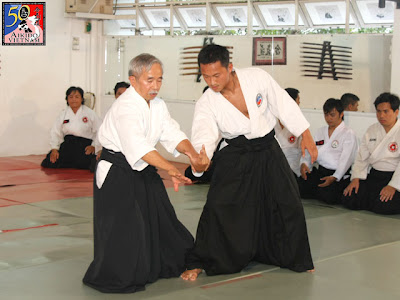
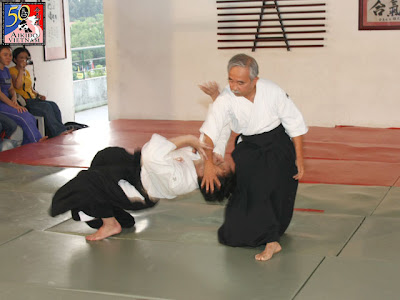
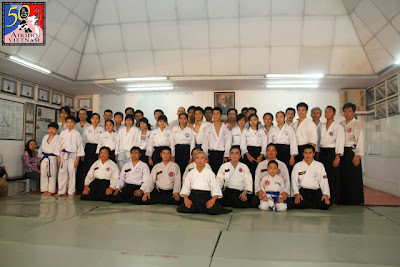
And since I neglected to talk about a visit from Phong Sensei some weeks back, I'll just say that I found him very impressive. He is a surprisingly small person, but so joyfully dynamic and powerful in his technique. Here are a few pictures:
He admonished me to keep flowing. If I don’t get one technique keep moving into the next. That was nice to hear. It’s not stressed enough, I think. Also, he talked about keeping my hands centered and demonstrated what he meant with a version of sankyo that reminded me of watching videos of Tissier Sensei.
Later, he called attention to initial movement, speaking of Saotome Sensei and the way he enters irimi, a slight movement taking him deep and off the line, small, calm, specific, hands rising and cutting down in perfect sword form.
I guess I don’t have any conclusions to make today. I’m more or less just thinking things through, and making myself aware that I am going to have to pay more attention to centering, relaxing, maintaining good form. In my effort to move and flow, I may be sacrificing form and composure. Perhaps I need to look again at my jiyu waza practice; I think I am on the right track but maybe just a shift in attitude would help, maybe a shift to something more centered, balanced, calm and sword oriented.
And since I neglected to talk about a visit from Phong Sensei some weeks back, I'll just say that I found him very impressive. He is a surprisingly small person, but so joyfully dynamic and powerful in his technique. Here are a few pictures:
Subscribe to:
Posts (Atom)