Here is an idea to explore. This morning I took a few minutes to play with a very basic kaeshi waza, receive ikkyo and turn it around and give it back. It was harder to get than I would have thought. Part of the problem was the language barrier. I couldn't really explain to my uke what I wanted to do and his level of resistance made it difficult to find the technique to practice it.
Then I tried something a little different. Instead of turning my body where I thought it was supposed to go I simply turned my body where it needed to go to keep my own hand lined up on my center. The result was that I started to get the reversal as well.
Then a little later as I was receiving shihonage, I tried the same principle. Instead of trying to move myself where I thought I should to take ukemi, I just moved my body to keep my center lined up with hand. In other words, I followed my hand with my center. The result was a very natural and relaxed ukemi.
It seems to me that this is what we generally do as tori. We line up our centers. I don't force my hand to my center; I gently move my center so it lines up with my hand and then I have a natural and easy power. So it makes total sense that I should be practicing the same approach as uke. After all, there are not two aikidos, one for offense and one for defense. As I move into a more fluid practice, there isn't even much distinction between tori and uke, there's just a constant flow pursuing alignment and the power that emenates from it.
Tuesday, October 21, 2008

Sunday, September 21, 2008
Looking at Yonkyo
Yonkyo is hard. In fact, it is harder than it should be. I can't believe that a technique only works on some people some of the time would still be included in the basic curriculum. Therefore, I think that I'm missing some crucial element.
I've been looking at its mechanics and applications. First of all, it seems make more sense if I take it from a failed sankyo. Meeting resistance in sankyo, I can reverse direction and take yonkyo. That seems to help. Also, on occasion, yonkyo just appears; I've got uke's arm and uke is unbalanced. Uke's arm (elbow, shoulder) are arranged so that yonkyo makes sense. I haven't forced yonkyo, only spotted a timely opportunity.
This week I have started to look at the second hand. The focus is always on the hand that seizes the pressure point. Often it is hard to follow that grip with a movement that controls uke's shoulder and unbalances him. So I'm looking at my other hand. In every other technique the hands are cutting in sword fashion so why not yonkyo? What if that second hand, the one gripping the back of uke's hand, were to cut towards uke's center? What if it cut almost horizontally across uke's do (floating rib)?
I have a strong intuitive feeling that there is something right in all of that. Yonkyo starts to feel more akin to nikyo, sankyo or kote-gaeshi, all of which become available options as uke puts up a fight.
I tried this today with Hoang, a college student who trains at the dojo. I felt like I was getting the strongest, cleanest yonkyo I've ever had. It was a fast, sharp application. I asked him about it. He seemed to think it was solid but language is always a problem. On the other hand, Hoang is generally susceptible to yonkyo and is a cooperative uke. I'll need to work with a variety of uke's particularly the more combative and non-compliant ones and also some folks with bigger wrists.
I've been looking at its mechanics and applications. First of all, it seems make more sense if I take it from a failed sankyo. Meeting resistance in sankyo, I can reverse direction and take yonkyo. That seems to help. Also, on occasion, yonkyo just appears; I've got uke's arm and uke is unbalanced. Uke's arm (elbow, shoulder) are arranged so that yonkyo makes sense. I haven't forced yonkyo, only spotted a timely opportunity.
This week I have started to look at the second hand. The focus is always on the hand that seizes the pressure point. Often it is hard to follow that grip with a movement that controls uke's shoulder and unbalances him. So I'm looking at my other hand. In every other technique the hands are cutting in sword fashion so why not yonkyo? What if that second hand, the one gripping the back of uke's hand, were to cut towards uke's center? What if it cut almost horizontally across uke's do (floating rib)?
I have a strong intuitive feeling that there is something right in all of that. Yonkyo starts to feel more akin to nikyo, sankyo or kote-gaeshi, all of which become available options as uke puts up a fight.
I tried this today with Hoang, a college student who trains at the dojo. I felt like I was getting the strongest, cleanest yonkyo I've ever had. It was a fast, sharp application. I asked him about it. He seemed to think it was solid but language is always a problem. On the other hand, Hoang is generally susceptible to yonkyo and is a cooperative uke. I'll need to work with a variety of uke's particularly the more combative and non-compliant ones and also some folks with bigger wrists.
California Uke
This morning we had a guest at the dojo, a udansha from California who trains under Phong Sensei. He’s Vietnamese-American and hadn’t been back to Vietnam in 32 years. Consequently, when he got going on the mat he was sweating hard. Combine that with his physical build (short, stocky, think wrists and a musculature wired like coils of steel springs), and you have a very challenging uke. His limbs scarcely moved and his grip readily slipped off. I really struggled to get a hold on him and apply technique. My most effective efforts were some sutemi waza; I’ve really started to get into yoko otoshi.
He admonished me to keep flowing. If I don’t get one technique keep moving into the next. That was nice to hear. It’s not stressed enough, I think. Also, he talked about keeping my hands centered and demonstrated what he meant with a version of sankyo that reminded me of watching videos of Tissier Sensei.
Later, he called attention to initial movement, speaking of Saotome Sensei and the way he enters irimi, a slight movement taking him deep and off the line, small, calm, specific, hands rising and cutting down in perfect sword form.
I guess I don’t have any conclusions to make today. I’m more or less just thinking things through, and making myself aware that I am going to have to pay more attention to centering, relaxing, maintaining good form. In my effort to move and flow, I may be sacrificing form and composure. Perhaps I need to look again at my jiyu waza practice; I think I am on the right track but maybe just a shift in attitude would help, maybe a shift to something more centered, balanced, calm and sword oriented.
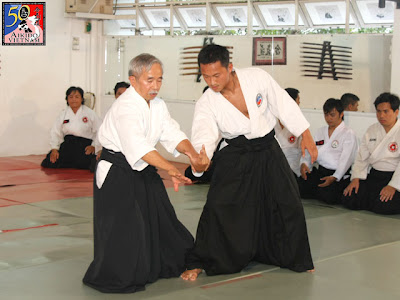
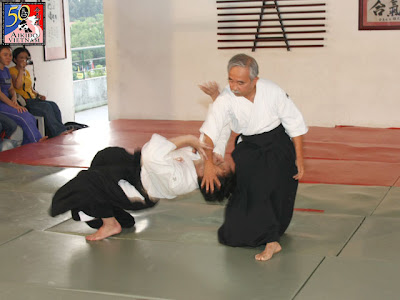
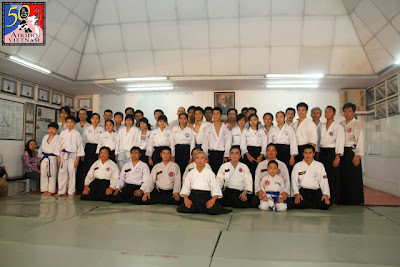
And since I neglected to talk about a visit from Phong Sensei some weeks back, I'll just say that I found him very impressive. He is a surprisingly small person, but so joyfully dynamic and powerful in his technique. Here are a few pictures:
He admonished me to keep flowing. If I don’t get one technique keep moving into the next. That was nice to hear. It’s not stressed enough, I think. Also, he talked about keeping my hands centered and demonstrated what he meant with a version of sankyo that reminded me of watching videos of Tissier Sensei.
Later, he called attention to initial movement, speaking of Saotome Sensei and the way he enters irimi, a slight movement taking him deep and off the line, small, calm, specific, hands rising and cutting down in perfect sword form.
I guess I don’t have any conclusions to make today. I’m more or less just thinking things through, and making myself aware that I am going to have to pay more attention to centering, relaxing, maintaining good form. In my effort to move and flow, I may be sacrificing form and composure. Perhaps I need to look again at my jiyu waza practice; I think I am on the right track but maybe just a shift in attitude would help, maybe a shift to something more centered, balanced, calm and sword oriented.
And since I neglected to talk about a visit from Phong Sensei some weeks back, I'll just say that I found him very impressive. He is a surprisingly small person, but so joyfully dynamic and powerful in his technique. Here are a few pictures:
Thursday, August 28, 2008
Response to Nikyo
I've been having fun playing with this. It seems to be a viable response to nikyo, at least where the nikyo involves pinning the wrist to shoulder area as opposed to keeping it at a distance.
Basically, when I feel tori taking the nikyo, I follow along. He's drawing me in and down, so I move purposefully in and down toward the lead side. This helps take some the pressure off my wrist.
Without pause, I immediately take a second step deep toward his other side, swing my hips around, and begin to sit down on that heel. As I drop, the first leg straightens naturally and checks his lead leg. His lead shoulder that was being used to secure nikyo is now being drawn out and down by that same nikyo.
Tori has become uke and takes a big fall.
This is a basic sutemi waza (sacrifice technique). I don't know exactly what it is called, but I see it in judo all the time. Judo is great for sutemi. The only difference is that I am applying it in response to a technique (nikyo) that I don't think exists in judo.
I'd like to learn more about judo, some proper, formal training. Next week I'll be in Guangzhou, China where they have no aikido, so I am hoping to find some judo players to work with while I am there. I can't imagine two weeks of no practice. Hopefully, it'll be an opportunity to prepare me for next year's move to Belize where again, they have judo but no aikido.
Basically, when I feel tori taking the nikyo, I follow along. He's drawing me in and down, so I move purposefully in and down toward the lead side. This helps take some the pressure off my wrist.
Without pause, I immediately take a second step deep toward his other side, swing my hips around, and begin to sit down on that heel. As I drop, the first leg straightens naturally and checks his lead leg. His lead shoulder that was being used to secure nikyo is now being drawn out and down by that same nikyo.
Tori has become uke and takes a big fall.
This is a basic sutemi waza (sacrifice technique). I don't know exactly what it is called, but I see it in judo all the time. Judo is great for sutemi. The only difference is that I am applying it in response to a technique (nikyo) that I don't think exists in judo.
I'd like to learn more about judo, some proper, formal training. Next week I'll be in Guangzhou, China where they have no aikido, so I am hoping to find some judo players to work with while I am there. I can't imagine two weeks of no practice. Hopefully, it'll be an opportunity to prepare me for next year's move to Belize where again, they have judo but no aikido.
Wednesday, July 23, 2008
Boxing Lessons
Thinking about boxing, clearly there is no one fixed approach to engaging the adversary. Unless you want to walk into a hook punch. The big idea is circular footwork, trying to come at and dominate the opponent’s center line without giving your own away. The big idea is to doggedly pursue the target zone, bobbing, weaving, slipping and dismissing the obstacles (punches) that come along and not making a big deal of them.
Is aikido any different? Probably not – or at least it shouldn’t be. Boxing is well proven and boxers incredibly effective and efficient. It is probably smart to take a page from their book. But how do I translate these strategies into aikido, into jiyu waza, randori?
Certainly, I always want the center line. I have been working that each day with jiyu waza, focusing on mirror movements of ikkyo and irimi. I've been coming very direct and assertive and feeling good about it. But this week I started allowing uke to include a little atemi as opposed to just grabbing, and now I am less certain. I think that at the same time that he going after uke's center line I am also giving mine away. The result is a clash where I tend to stick then win out by my size advantage.
I'm coming straight at uke. If we were boxing, I'd probably end up taking a jab right on the chin. Not good.
I keep looking for a fool proof movement that covers all the possibilities. I build little charts to see where the holes might be. I have never built a chart without holes. It might not be the right approach.
A better way may be to come at it like a boxer, moving fluidly, targeting my zone and not getting distracted by uke's grabs and strikes. Just keep moving. Just keep pursuing the goal of uke's balance, of turning uke's chin and upsetting his poise. Let the straight in charge give way to more circular footwork, to angling, to slanting, to turning a little tenkan.
Thinking about it, the classic ikkyo that I've studied was never a direct charge. It always involved a slight off the line approach. And irimi has an angle of its own. I should get back to that in my jiyu-waza.
It's something to work on.
Is aikido any different? Probably not – or at least it shouldn’t be. Boxing is well proven and boxers incredibly effective and efficient. It is probably smart to take a page from their book. But how do I translate these strategies into aikido, into jiyu waza, randori?
Certainly, I always want the center line. I have been working that each day with jiyu waza, focusing on mirror movements of ikkyo and irimi. I've been coming very direct and assertive and feeling good about it. But this week I started allowing uke to include a little atemi as opposed to just grabbing, and now I am less certain. I think that at the same time that he going after uke's center line I am also giving mine away. The result is a clash where I tend to stick then win out by my size advantage.
I'm coming straight at uke. If we were boxing, I'd probably end up taking a jab right on the chin. Not good.
I keep looking for a fool proof movement that covers all the possibilities. I build little charts to see where the holes might be. I have never built a chart without holes. It might not be the right approach.
A better way may be to come at it like a boxer, moving fluidly, targeting my zone and not getting distracted by uke's grabs and strikes. Just keep moving. Just keep pursuing the goal of uke's balance, of turning uke's chin and upsetting his poise. Let the straight in charge give way to more circular footwork, to angling, to slanting, to turning a little tenkan.
Thinking about it, the classic ikkyo that I've studied was never a direct charge. It always involved a slight off the line approach. And irimi has an angle of its own. I should get back to that in my jiyu-waza.
It's something to work on.
Monday, July 14, 2008
Trouble With the Kote-Gaeshi Pin
I've just had a realization regarding the kote-gaeshi pin.
Typically, when taking kote-gaeshi, uke lands on his back with tori still holding uke's wrist and arm in an advantageous position. Tori then cranks uke's arm to roll him on to his belly in order to apply the pin.
The problem is always an uncooperative or sluggish uke who decides not to roll over. It's quite difficult to force uke over and the situation easily devolves into a wrestling match. That's not very aiki, so what am I missing?
Now, I think I understand what I am missing.
It's really no different than an uke who refuses to follow tori around when tori controls his arm. He lets tori get behind him and then refuses to turn himself. The answer there is obvious. If uke refuses to participate in the fight, then there is no fight. But equally valid is tori's option of just choking out the dolt who stands there with his back to him refusing to move.
Same situation. From kote-gaeshi, uke lands on his back then refuses to roll over or move. There are two options. One, the fight is over. Two, tori can just kick and stomp him or take a front mount and start punching him in the face. I don't think that any of that is going to sound good to uke. Instead, the most logical and natural response for anyone being thrown on to their back is to try to get back up.
To get up from your back, you pretty much have to roll over at least partially to get to your knees. When uke moves to regain his feet, tori simply follows the movement and secures the pin. Tori doesn't need to force uke over. Uke wants to turn over, not to submit, but to get back up. Tori just follows uke's intention and uses the arm to steer uke into the pin.
I tested my idea out today. So far it is working smoothly, easily, and much more like what I imagine aikido to be all about.
Typically, when taking kote-gaeshi, uke lands on his back with tori still holding uke's wrist and arm in an advantageous position. Tori then cranks uke's arm to roll him on to his belly in order to apply the pin.
The problem is always an uncooperative or sluggish uke who decides not to roll over. It's quite difficult to force uke over and the situation easily devolves into a wrestling match. That's not very aiki, so what am I missing?
Now, I think I understand what I am missing.
It's really no different than an uke who refuses to follow tori around when tori controls his arm. He lets tori get behind him and then refuses to turn himself. The answer there is obvious. If uke refuses to participate in the fight, then there is no fight. But equally valid is tori's option of just choking out the dolt who stands there with his back to him refusing to move.
Same situation. From kote-gaeshi, uke lands on his back then refuses to roll over or move. There are two options. One, the fight is over. Two, tori can just kick and stomp him or take a front mount and start punching him in the face. I don't think that any of that is going to sound good to uke. Instead, the most logical and natural response for anyone being thrown on to their back is to try to get back up.
To get up from your back, you pretty much have to roll over at least partially to get to your knees. When uke moves to regain his feet, tori simply follows the movement and secures the pin. Tori doesn't need to force uke over. Uke wants to turn over, not to submit, but to get back up. Tori just follows uke's intention and uses the arm to steer uke into the pin.
I tested my idea out today. So far it is working smoothly, easily, and much more like what I imagine aikido to be all about.
Monday, June 30, 2008
Big Ideas
During the last month I have been trying to transform my aikido practice into something new. New to me at least.
I've taken some ideas from different sources and I am trying to unify and integrate them into something practical and meaningful. First, here is a list of some of the more important ideas.
The Fence. The fence is a very common sense idea that I am lifting from Geoff Thompson who has authored a whole series of books and DVDs on practical martial applications. The fence is simply a guard up position, but whereas a normal martial arts guard signals your opponent that you are about to go all Bruce Lee on him, the fence very casually says that you don't want any trouble. The hands are palm out, staggered, hovering around chest level. They keep him out of your face, bring you closer into his guard, help you judge distance, and allow you to either attack pre-emptively or respond to his attack. From an aikido perspective, the fence brings my hands up higher into a less passive or reactive starting point.
Mirrors. This comes from aikidoist John Bailey who practices a more contemporary aikido. Basically, a mirror is one body movement that produces two or more techniques depending on uke's position. For me, right now, the major mirror movement I am working on is ikkyo/ irimi. With my fence up, uke grabs my arm cross handed and I move right through him into ikkyo. Uke grabs again, this time non-cross handed, and I perform the same movement which now results in irimi-nage. One movement, two different results. I do not need to wait for uke to clarify his attack (which would be too late anyway). With my fence up, I sense the immediacy of uke's attack and move to meet him half way.
Compliments. Also from John Bailey. I think of compliments as an no nonsense approach to henka waza. Why complicate things? Certain techniques (when encountering resistance) feed logically into others. When they do, take them. I am seeing that compliments really tie in well with the next idea, pillars.
Pillars. I have seen this idea in several places. Basically, the idea is that not all techniques are created equal. Some are more straight-forward and universally applicable. These are pillars. One of my pillars is ikkyo (also part of my mirrors practice). Being a pillar, I will generally go for ikkyo whenever possible. But sometimes it may crumble, especially under stress. Then I look for its compliments, techniques that logically flow from and incorporate uke's resistance. For me, I often end up with sankyo (which can then take me back to irimi which is another pillar). I like pillars for a few reasons. For one, it gives me a focus; I no longer have dozens of options to choose from for responding to an attack. I just have to hardwire a few fundamental techniques. Pillars also lets me off the hook. A lot of techniques are just plain hard to make work most of the time. Pillars says that that's all right. They aren't supposed to work most of the time. Your core (pillar) techniques are the ones that are supposed to be your bread and butter; the rest are supplementary for meeting specific instances of resistance.
At the moment, my pillars are ikkyo, irimi, sumi otoshi (for lack of a better name), and shihonage. Focusing on these four shows a lot of examples of mirroring.
I've taken some ideas from different sources and I am trying to unify and integrate them into something practical and meaningful. First, here is a list of some of the more important ideas.
- The fence.
- Mirrors.
- Compliments.
- Pillars.
The Fence. The fence is a very common sense idea that I am lifting from Geoff Thompson who has authored a whole series of books and DVDs on practical martial applications. The fence is simply a guard up position, but whereas a normal martial arts guard signals your opponent that you are about to go all Bruce Lee on him, the fence very casually says that you don't want any trouble. The hands are palm out, staggered, hovering around chest level. They keep him out of your face, bring you closer into his guard, help you judge distance, and allow you to either attack pre-emptively or respond to his attack. From an aikido perspective, the fence brings my hands up higher into a less passive or reactive starting point.
Mirrors. This comes from aikidoist John Bailey who practices a more contemporary aikido. Basically, a mirror is one body movement that produces two or more techniques depending on uke's position. For me, right now, the major mirror movement I am working on is ikkyo/ irimi. With my fence up, uke grabs my arm cross handed and I move right through him into ikkyo. Uke grabs again, this time non-cross handed, and I perform the same movement which now results in irimi-nage. One movement, two different results. I do not need to wait for uke to clarify his attack (which would be too late anyway). With my fence up, I sense the immediacy of uke's attack and move to meet him half way.
Compliments. Also from John Bailey. I think of compliments as an no nonsense approach to henka waza. Why complicate things? Certain techniques (when encountering resistance) feed logically into others. When they do, take them. I am seeing that compliments really tie in well with the next idea, pillars.
Pillars. I have seen this idea in several places. Basically, the idea is that not all techniques are created equal. Some are more straight-forward and universally applicable. These are pillars. One of my pillars is ikkyo (also part of my mirrors practice). Being a pillar, I will generally go for ikkyo whenever possible. But sometimes it may crumble, especially under stress. Then I look for its compliments, techniques that logically flow from and incorporate uke's resistance. For me, I often end up with sankyo (which can then take me back to irimi which is another pillar). I like pillars for a few reasons. For one, it gives me a focus; I no longer have dozens of options to choose from for responding to an attack. I just have to hardwire a few fundamental techniques. Pillars also lets me off the hook. A lot of techniques are just plain hard to make work most of the time. Pillars says that that's all right. They aren't supposed to work most of the time. Your core (pillar) techniques are the ones that are supposed to be your bread and butter; the rest are supplementary for meeting specific instances of resistance.
At the moment, my pillars are ikkyo, irimi, sumi otoshi (for lack of a better name), and shihonage. Focusing on these four shows a lot of examples of mirroring.
Subscribe to:
Posts (Atom)